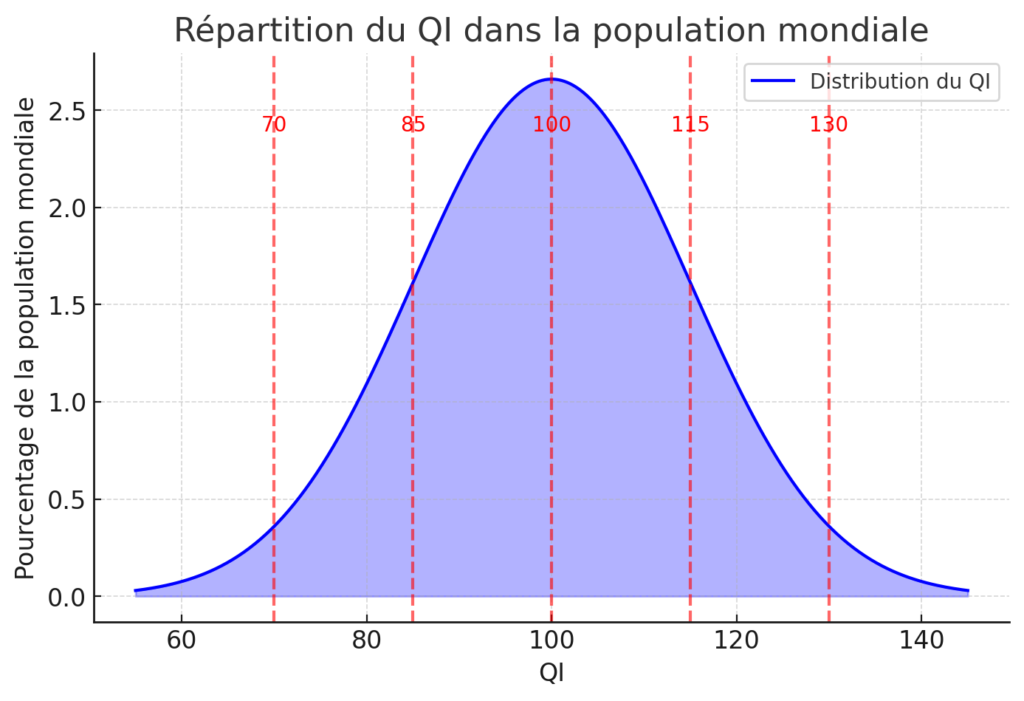
25% of the population lacks the cognitive abilities to reach a good level of language proficiency, which is essential.

A question that often arises is that of destiny. Do we really have control over our lives?

Since I need to find a job, I find myself in the situation of someone who belongs to the 25.25% of the world’s population with an IQ lower than 90, which is supposedly the IQ necessary to use a language adequately for all administrative tasks.
If I’m not completely illiterate in Japanese, I’m far from a native level when it comes to topics or subjects I haven’t covered. This goes without saying, but “instant knowledge” doesn’t exist; we only know what we’ve learned.

The point of today’s reflection is not to feel sorry for myself, but rather to highlight the difficulties that more than a quarter of the world’s population face on a daily basis.

Not being comfortable reading is not just a burden for reading but also for learning, obviously. And someone struggling in their language will face other additional difficulties, such as the fear of expressing themselves, the fear of mockery, a sense of inferiority, and self-denial.

We quickly forget these differences, and we judge too quickly, in a more general way.

Does a person not express themselves, for example, because they don’t want to, or because they can’t?

Does the fact that the vast majority of people have no issues with language mean we should disregard others? Just because they don’t have the necessary abilities to do so?

The example of language is easy to understand for an expatriate who doesn’t master the language of the country they live in.

Immigration is a complicated issue. But in very simple terms, if there is no “need” to leave one’s country in the first place, there would be no immigration.

Looking at things from a global perspective, it almost becomes obvious that to solve immigration problems, providing the necessary resources to the countries of the people who emigrate is one of the key factors.

The reasons for fleeing one’s country are diverse, of course. But extreme poverty, malnutrition, and directly linked to these, lack of education, are among the determining factors.

Anyway, I need to work on my Japanese.

Our latest tales

  • Going through hardships

    Going through hardships

    Esperia didn’t become the world we know it as—one of peace and harmony—in a day, nor easily. Every Esper had to go through hardships, but the end of the Chaos War finally became a much-needed rallying point, uniting and combining the desire for true peace for everyone. “Every Esper, at their own level, would have

    Read more

  • Beautiful Scenery

    Beautiful Scenery

    Kenko, the Great Element of Earth, often worked together with Vati, the Great Element of Water, and Gurumin, the Great Element of Wind. The three of them were often charged with thinking ahead so that nature could be preserved and its importance maintained in Esperia. Their own elements made them naturally connected to the beautiful

    Read more

  • A Fresh Start

    A Fresh Start

    Trying to build a world where peace would prevail was not an easy mission at all. There were so many things to take into account, but the Seven Shapes agreed that flexibility should remain a point of focus. Because flexibility allows for communication, the ability to try new things, and even, at times, to take

    Read more

  • Sincere and honest

    Sincere and honest

    The Element of Wind focused on interactions with others more than the other elements. Of course, being of another element like Fire or Water didn’t prevent one from leaning toward this trait, but the Espers of the Wind had the most natural affinity for it. Instinctively, they could sense the presence of their inner Shadow,

    Read more

  • Meaningful

    Meaningful

    There were many debates taking place in the Great Library of Esperia, a place where all the Espers of the Five Elements could gather, discuss with one another, and exchange ideas and opinions. Having different backgrounds made the discussions rather interesting, but the rules were set by the Seven Shapes so that there would be

    Read more

  • Rise and Fall

    Rise and Fall

    It had been a while since we last took a look at Guruko and Simba, her little platypus companion. As they were studying human society on Earth, both were surprised and shocked by its development. “How can these living beings sometimes be capable of creating such wonderful things, yet at other times be so cruel

    Read more

  • It can’t be done overnight

    It can’t be done overnight

    Though the discovery of the StarDust was a huge leap forward for Esperia, there was still a lot of work to do. Indeed, some Espers still couldn’t believe in it and did not accept the fact that they had within them a Shadow they couldn’t control. However, the Seven Shapes truly believed that harmony in

    Read more

  • Becoming One Whole

    Becoming One Whole

    The discovery of the StarDust by the Espers marked the beginning of a new era of peace, led by the Seven Shapes. The StarDust was the perfect example of the Five Elements blending to become one whole. When they decided to write about it, the Seven Shapes thought deeply about this idea. “From the beginning,

    Read more