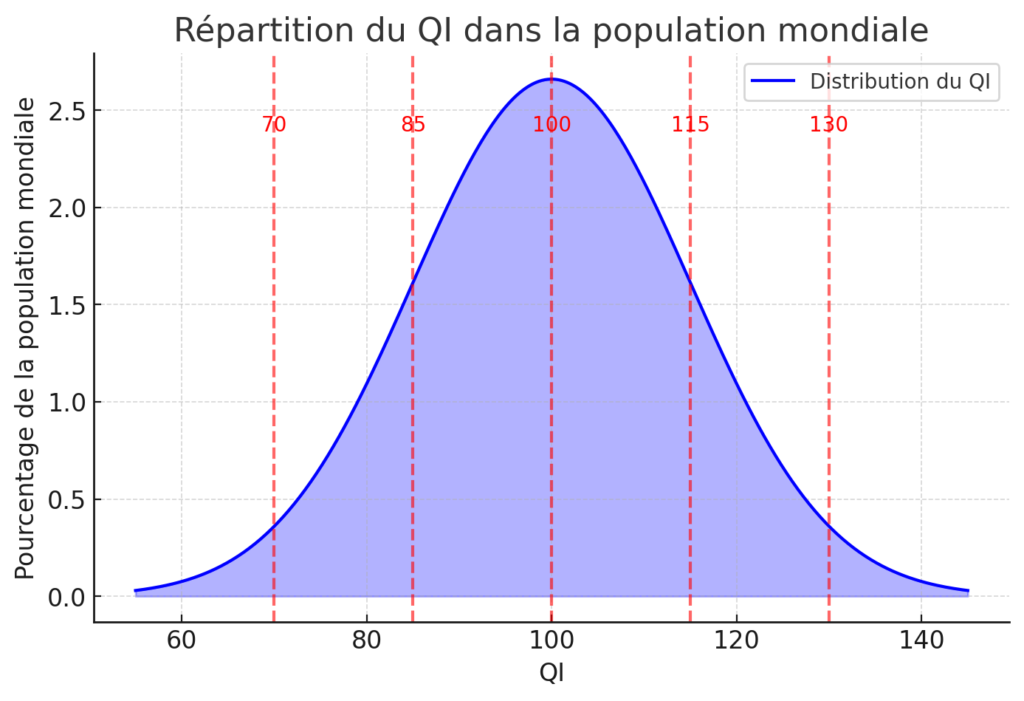
25% of the population lacks the cognitive abilities to reach a good level of language proficiency, which is essential.

A question that often arises is that of destiny. Do we really have control over our lives?

Since I need to find a job, I find myself in the situation of someone who belongs to the 25.25% of the world’s population with an IQ lower than 90, which is supposedly the IQ necessary to use a language adequately for all administrative tasks.
If I’m not completely illiterate in Japanese, I’m far from a native level when it comes to topics or subjects I haven’t covered. This goes without saying, but “instant knowledge” doesn’t exist; we only know what we’ve learned.

The point of today’s reflection is not to feel sorry for myself, but rather to highlight the difficulties that more than a quarter of the world’s population face on a daily basis.

Not being comfortable reading is not just a burden for reading but also for learning, obviously. And someone struggling in their language will face other additional difficulties, such as the fear of expressing themselves, the fear of mockery, a sense of inferiority, and self-denial.

We quickly forget these differences, and we judge too quickly, in a more general way.

Does a person not express themselves, for example, because they don’t want to, or because they can’t?

Does the fact that the vast majority of people have no issues with language mean we should disregard others? Just because they don’t have the necessary abilities to do so?

The example of language is easy to understand for an expatriate who doesn’t master the language of the country they live in.

Immigration is a complicated issue. But in very simple terms, if there is no “need” to leave one’s country in the first place, there would be no immigration.

Looking at things from a global perspective, it almost becomes obvious that to solve immigration problems, providing the necessary resources to the countries of the people who emigrate is one of the key factors.

The reasons for fleeing one’s country are diverse, of course. But extreme poverty, malnutrition, and directly linked to these, lack of education, are among the determining factors.

Anyway, I need to work on my Japanese.


Our latest tales

  • Zeiniku the Sedentary

    Zeiniku the Sedentary

    Even in the land of the element of Earth, which was supposed to represent Health above all else, comfort and changes in lifestyle since the beginning of the use of magic had transformed the daily lives of the Espers. Zeiniku was probably the typical example of a sedentary person, seeing himself above all as free…

    Read more

  • Fiction and Reality

    Fiction and Reality

    The Age of Magic had given life to new machines, which were also capable of creating, writing, or speaking. Just like the Espers, they were capable of inventing stories and creating virtual worlds. For the Espers, distinguishing fiction from reality was becoming increasingly difficult in a world where the virtual and the real were blending…

    Read more

  • Camaraderie and Solidarity

    Camaraderie and Solidarity

    Cha Cha, our platypus friend, had a vision for a world finally at peace. Like the Seven Shapes, who had joined their forces in an attempt to make the world fairer for everyone, he had understood that, for this to work, the values that needed to be brought forward were camaraderie and solidarity. But not…

    Read more

  • An Ideal of Kindness Toward All

    An Ideal of Kindness Toward All

    Lune Lune, our little cat friend of the Water element, had been taken in by Guruo. Guruo, who was trying to do his very best, appeared to some of the others as if he were deliberately trying to be the teachers’ favorite. There was, of course, a great deal of jealousy, which also revealed a…

    Read more

  • A Forgotten Value Called Humility

    A Forgotten Value Called Humility

    The widespread use of magic had changed the landscape and the way of life of the Espers across the world. Magic had also paved the way for the creation of new technologies that allowed them to remain active even at night and operate machines far more powerful than their own muscles. Thus, the Espers were…

    Read more

  • Taking Time

    Taking Time

    The events that preceded the beginning of the War of Chaos nevertheless carried a sense of déjà vu. Each of the elements was caught in a frantic race to develop new technologies that would allow them, on the one hand, to satisfy their desire to dominate the world and, on the other, to pursue their…

    Read more

  • Outraged by the World’s Wrongs

    Outraged by the World’s Wrongs

    Before the War of Chaos, Esperia faced two major problems, yet they remained hidden in the shadow of the splendor of the new technologies created through the ever-growing use of magic across the world. And these two problems concerned everyone, regardless of their element. A number of people had begun to examine the use of…

    Read more

  • Changing Mindsets

    Changing Mindsets

    Regretting the past does not change the world. But it can help prevent us from repeating the mistakes made before. It was with this mindset that the Seven Shapes had decided to try to change mindsets for a better world, fairer for everyone and finally in harmony. This task, which had once seemed completely utopian,…

    Read more