25% of the population lacks the cognitive abilities to reach a good level of language proficiency, which is essential.

A question that often arises is that of destiny. Do we really have control over our lives?

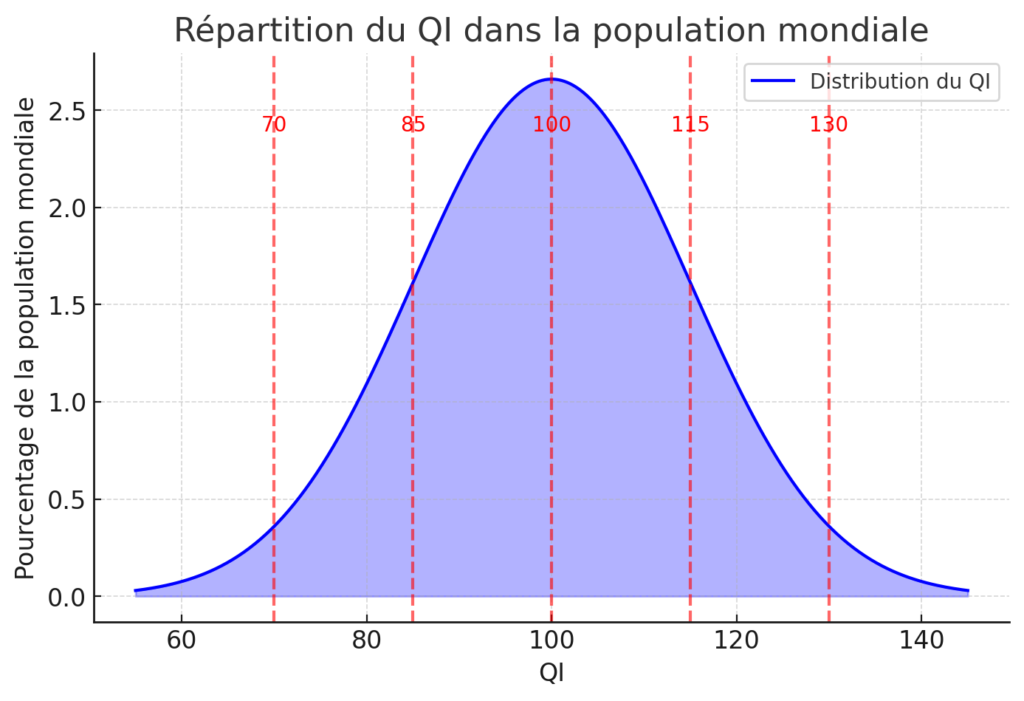
Since I need to find a job, I find myself in the situation of someone who belongs to the 25.25% of the world’s population with an IQ lower than 90, which is supposedly the IQ necessary to use a language adequately for all administrative tasks.
If I’m not completely illiterate in Japanese, I’m far from a native level when it comes to topics or subjects I haven’t covered. This goes without saying, but “instant knowledge” doesn’t exist; we only know what we’ve learned.

The point of today’s reflection is not to feel sorry for myself, but rather to highlight the difficulties that more than a quarter of the world’s population face on a daily basis.

Not being comfortable reading is not just a burden for reading but also for learning, obviously. And someone struggling in their language will face other additional difficulties, such as the fear of expressing themselves, the fear of mockery, a sense of inferiority, and self-denial.

We quickly forget these differences, and we judge too quickly, in a more general way.

Does a person not express themselves, for example, because they don’t want to, or because they can’t?

Does the fact that the vast majority of people have no issues with language mean we should disregard others? Just because they don’t have the necessary abilities to do so?

The example of language is easy to understand for an expatriate who doesn’t master the language of the country they live in.

Immigration is a complicated issue. But in very simple terms, if there is no “need” to leave one’s country in the first place, there would be no immigration.

Looking at things from a global perspective, it almost becomes obvious that to solve immigration problems, providing the necessary resources to the countries of the people who emigrate is one of the key factors.

The reasons for fleeing one’s country are diverse, of course. But extreme poverty, malnutrition, and directly linked to these, lack of education, are among the determining factors.

Anyway, I need to work on my Japanese.


Our latest tales

  • Unfounded

    Unfounded

    To rebuild Esperia from the perspective of harmony between the different elements, it was essential to question unfounded truths. Centuries of war and history cannot disappear in a single instant. Prejudices and unfounded rumors persist. It was on these very points that the Water Espers, guided by the Forme of Wisdom Vati, bore the heavy

    Read more

  • Gambling on the Future of the World

    Gambling on the Future of the World

    Since the birth of Atma, the Shape of Balance, it had become easier for the Espers to understand that a life in harmony with nature was the path forward for all. But some Espers, whose inner Shadow had, over the years, darkened their hearts enough, refused to accept this reality. “We are beings endowed with

    Read more

  • Again and Again

    Again and Again

    Even though Esperia had finally become a haven of peace, some Espers still remained reluctant to make efforts they had never made before.In particular, for those whose inner Shadow was predominant, the principles of One Daily Tale sounded like reproaches, again and again. “Why do I need to follow these rules now, when before I

    Read more

  • Many Exceptional People

    Many Exceptional People

    Ancient myths tell of an era when a king, surrounded by exceptional people, succeeded in bringing peace to his kingdom. “What made them so different from the others?” asked a young Esper, eager to learn more about the story that intrigued him. Eklea, the Shape of Consciousness, began to smile and replied: “That is an

    Read more

  • Turning Around a Desperate Situation

    Turning Around a Desperate Situation

    Faya, the Shape of Willpower, understood better than anyone that sometimes it is easier to be in a desperate situation in order to turn it around. Does it sound a bit strange to you? “Usually, when everything is fine, we have many options to choose from. And the more choices we have, the more difficult

    Read more

  • Eating and Drinking to Excess

    Eating and Drinking to Excess

    When they wrote the Health section of One Daily Tale, the Seven Shapes were soon confronted with an issue that would return to them again and again: the inertia of habits and the strength of cultural myths. Kenko, the Shape of Health, was aware that for most of the Espers, an abundance of food was

    Read more

  • Stubborn and Narrow-Minded

    Stubborn and Narrow-Minded

    At the Great Library of Esperia, the Awareness Department was one of the most animated.The Element of Lightning was one of the most difficult to master because of its volatility. Today’s lesson in Eklea’s class was devoted to how easily we can become stubborn and narrow-minded. “Just like lightning magic, we quickly become stuck in

    Read more

  • Positive discussions

    Positive discussions

    There was an expression used in Esperia for situations in which opinions were enthusiastically exchanged and discussion was lively: “like the wind blowing.”But it is no surprise to us that the Element of Wind is involved, is it? Empathy can lead to debates that bear fruit, because the participants can tolerate opinions different from their

    Read more