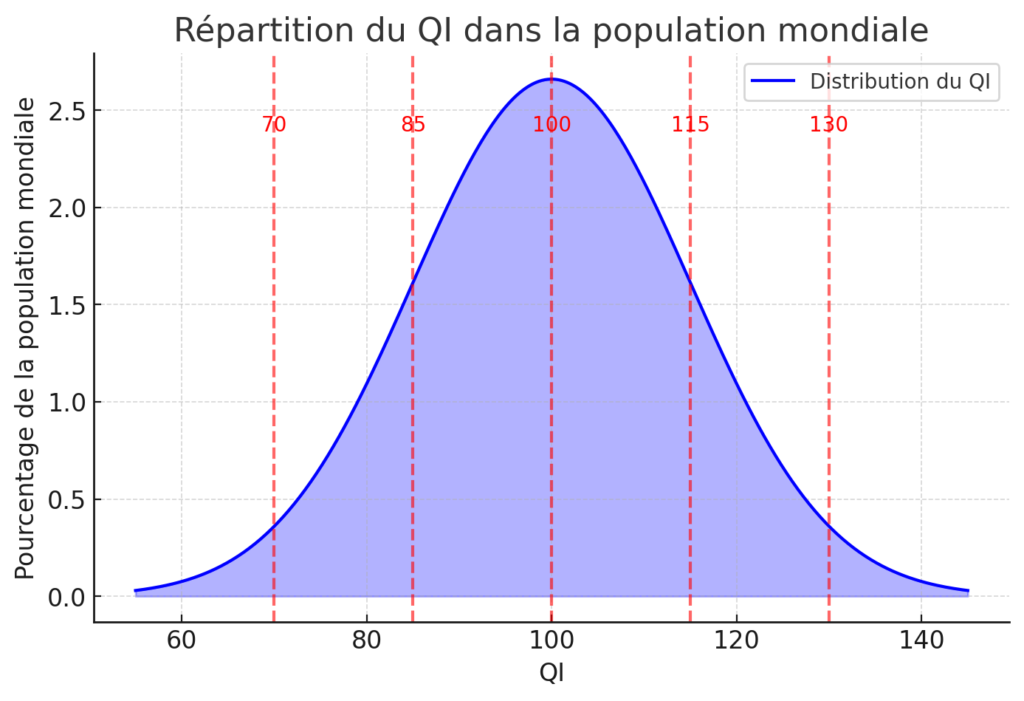
25% of the population lacks the cognitive abilities to reach a good level of language proficiency, which is essential.

A question that often arises is that of destiny. Do we really have control over our lives?

Since I need to find a job, I find myself in the situation of someone who belongs to the 25.25% of the world’s population with an IQ lower than 90, which is supposedly the IQ necessary to use a language adequately for all administrative tasks.
If I’m not completely illiterate in Japanese, I’m far from a native level when it comes to topics or subjects I haven’t covered. This goes without saying, but “instant knowledge” doesn’t exist; we only know what we’ve learned.

The point of today’s reflection is not to feel sorry for myself, but rather to highlight the difficulties that more than a quarter of the world’s population face on a daily basis.

Not being comfortable reading is not just a burden for reading but also for learning, obviously. And someone struggling in their language will face other additional difficulties, such as the fear of expressing themselves, the fear of mockery, a sense of inferiority, and self-denial.

We quickly forget these differences, and we judge too quickly, in a more general way.

Does a person not express themselves, for example, because they don’t want to, or because they can’t?

Does the fact that the vast majority of people have no issues with language mean we should disregard others? Just because they don’t have the necessary abilities to do so?

The example of language is easy to understand for an expatriate who doesn’t master the language of the country they live in.

Immigration is a complicated issue. But in very simple terms, if there is no “need” to leave one’s country in the first place, there would be no immigration.

Looking at things from a global perspective, it almost becomes obvious that to solve immigration problems, providing the necessary resources to the countries of the people who emigrate is one of the key factors.

The reasons for fleeing one’s country are diverse, of course. But extreme poverty, malnutrition, and directly linked to these, lack of education, are among the determining factors.

Anyway, I need to work on my Japanese.


Our latest tales

  • Avoiding Unfounded Rumors

    Avoiding Unfounded Rumors

    “We do not change completely from one day to the next. The years of conflict between the five elements will not be fully resolved in the blink of an eye. Nevertheless, now that common foundations have been established for everyone, it has become imperative to avoid continuing to spread unfounded rumors,” declared Vati, the Shape

    Read more

  • Emotional Fluctuations

    Emotional Fluctuations

    Since the birth of Atma, who had become the symbol of Balance, the Espers had understood one thing. True balance does not lie in a straight and continuously stable line, but is the result of fluctuations, like the waves of the sea that come and go. Gurumin, the Forme of Empathy, then connected this need

    Read more

  • Learning from the Past

    Learning from the Past

    If we cannot change the past, we can at least learn from it to create a future that will not repeat the same mistakes.This was one of the principles developed in the Time section of One Daily Tale. Of course, many topics are explored in this part, but today’s tale emphasized the benefits of knowing

    Read more

  • Leading by Example

    Leading by Example

    The Seven Shapes had understood one essential thing. For the Five elements, who had been fighting constantly until now, to finally reach a true and lasting peace, it was necessary to find common ground on which they could all rely, in order to rebuild new and healthy foundations for everyone. “The StarDust is the perfect

    Read more

  • Putting Ideas into Practice

    Putting Ideas into Practice

    “With ‘if,’ one could remake the world. But with ‘if,’ and by putting those ideas into practice, it becomes a reality.” It was with these words that a conference began in the Will section of the Great Library of Esperia. Faya, the Shape of Will, led the discussion and wanted to draw attention to the

    Read more

  • Overconfidence

    Overconfidence

    “Overconfidence in a talented person can lead to failure.”This sentence was the starting point of today’s discussion in the Health section of the Great Library of Esperia. A surprised young Esper asked the question: “I don’t understand the connection with health…” Kenko, the Shape of Health, replied gently: “This expression highlights the fact that when

    Read more

  • According to One’s Own Interests

    According to One’s Own Interests

    The discussion of the day, in the Consciousness section of the Great Library of Esperia, was quite thorny.Indeed, no one easily admits their faults, nor the fact that we first act according to our own interests. Eklea, the Shape of Consciousness, made the following remark: “As living beings among others, it is sometimes our primary

    Read more

  • Cruel and Heartless

    Cruel and Heartless

    “Have you ever hurt someone you love despite yourself?” asks Gurumin, the Shape of Empathy, to the Espers gathered for today’s discussion. “When I’m upset, I sometimes say things I don’t truly mean,” replies a young Esper. “Under the influence of strong emotions, we are indeed sometimes led to lose control of our actions—even with

    Read more