25% of the population lacks the cognitive abilities to reach a good level of language proficiency, which is essential.

A question that often arises is that of destiny. Do we really have control over our lives?

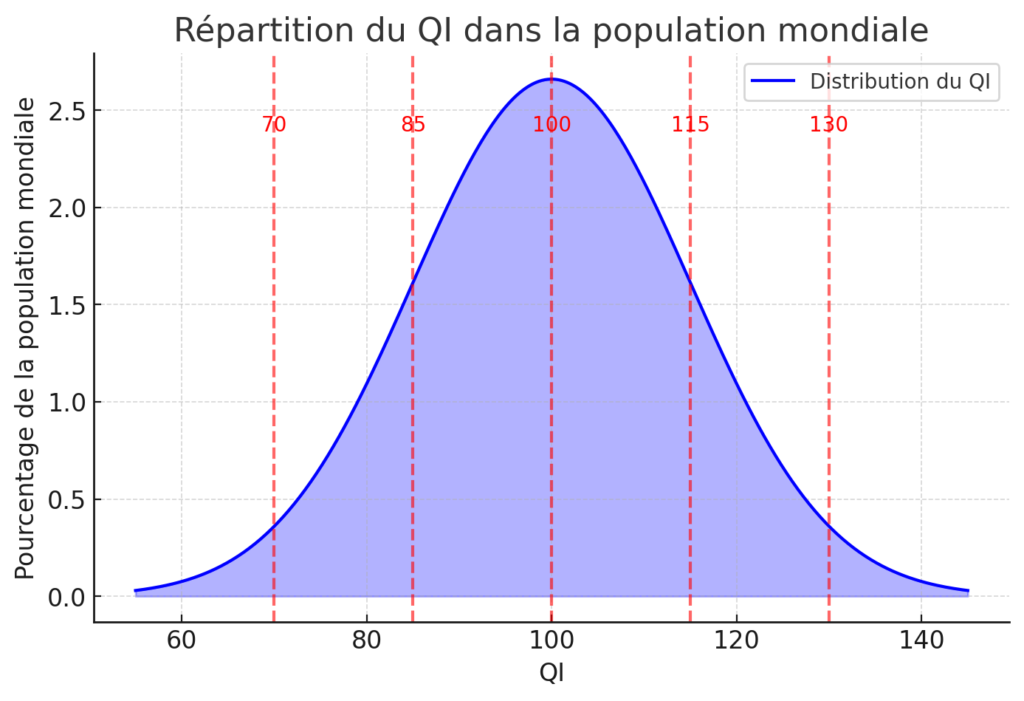
Since I need to find a job, I find myself in the situation of someone who belongs to the 25.25% of the world’s population with an IQ lower than 90, which is supposedly the IQ necessary to use a language adequately for all administrative tasks.
If I’m not completely illiterate in Japanese, I’m far from a native level when it comes to topics or subjects I haven’t covered. This goes without saying, but “instant knowledge” doesn’t exist; we only know what we’ve learned.

The point of today’s reflection is not to feel sorry for myself, but rather to highlight the difficulties that more than a quarter of the world’s population face on a daily basis.

Not being comfortable reading is not just a burden for reading but also for learning, obviously. And someone struggling in their language will face other additional difficulties, such as the fear of expressing themselves, the fear of mockery, a sense of inferiority, and self-denial.

We quickly forget these differences, and we judge too quickly, in a more general way.

Does a person not express themselves, for example, because they don’t want to, or because they can’t?

Does the fact that the vast majority of people have no issues with language mean we should disregard others? Just because they don’t have the necessary abilities to do so?

The example of language is easy to understand for an expatriate who doesn’t master the language of the country they live in.

Immigration is a complicated issue. But in very simple terms, if there is no “need” to leave one’s country in the first place, there would be no immigration.

Looking at things from a global perspective, it almost becomes obvious that to solve immigration problems, providing the necessary resources to the countries of the people who emigrate is one of the key factors.

The reasons for fleeing one’s country are diverse, of course. But extreme poverty, malnutrition, and directly linked to these, lack of education, are among the determining factors.

Anyway, I need to work on my Japanese.


Our latest tales

  • Education First

    Education First

    The world is filled with countless mysteries yet to be discovered, and with so many things that have been learned through the years since the beginning of civilizations. Not only for adults, but even more so for newly born Espers, it can feel overwhelming. That’s why Vati and the other Shapes believed that education needed…

    Read more

  • Trade-off

    Trade-off

    Atma found in Shala the figure of an older sister, someone with whom she could share her vision of the world. As the Shape of Balance, Atma was there to help the Espers remember that balance was essential for a bright StarDust. But she couldn’t help them directly—they had to understand and act on their…

    Read more

  • Once in a Lifetime

    Once in a Lifetime

    Shala would ask the young Espers what came to their minds when thinking about events that occur only once in a lifetime. A very intrepid child replied first: “The birth of my younger sister!” “Indeed, the birth of a new life is something that becomes a great challenge for the parents.” Vati added: “Raising a…

    Read more

  • As One

    As One

    The message of One Daily Tale was simple. The Five Elements working together in balance were the key to a bright StarDust for an Esper. This led to an Esper who could now consciously face his inner Shadow—something hidden from him without the light of his own StarDust. Those enlightened Espers could become living examples…

    Read more

  • Consistency of words and actions

    Consistency of words and actions

    After they created One Daily Tale, the Seven Shapes knew this was only the first step toward a peaceful Esperia. “From now on, the real challenge begins,” thought Vati, who understood better than anyone that while truth could be written with words, actions and behaviors did not always follow naturally. This was when Faya stepped…

    Read more

  • Gratitude for basic needs

    Gratitude for basic needs

    There was a saying that Kenko liked a lot, and though it did not directly concern health, she appreciated the idea behind it, as it reflected the principles taught by the other Shapes as well. “You should be grateful for the little things you receive — whether it is simple lodging or a meal.” Kenko…

    Read more

  • Third Eye

    Third Eye

    Eklea liked to use concrete examples to explain abstract notions that were difficult to grasp, especially for the younger Espers. This time, she used the example of a one-versus-one game played by two Espers. The game had a lot of depth, and a well-timed move could completely change the tide of the match. She said,…

    Read more

  • Pure and Upright

    Pure and Upright

    The Five Elements were representations of the dimensional layers that had to be blended in order to truly understand one’s inner self. Empathy was one of them, and when the Seven Shapes worked on a good description of compassion, they thought about what they saw in Gurumin: pureness. Her character and attitude were pure and…

    Read more