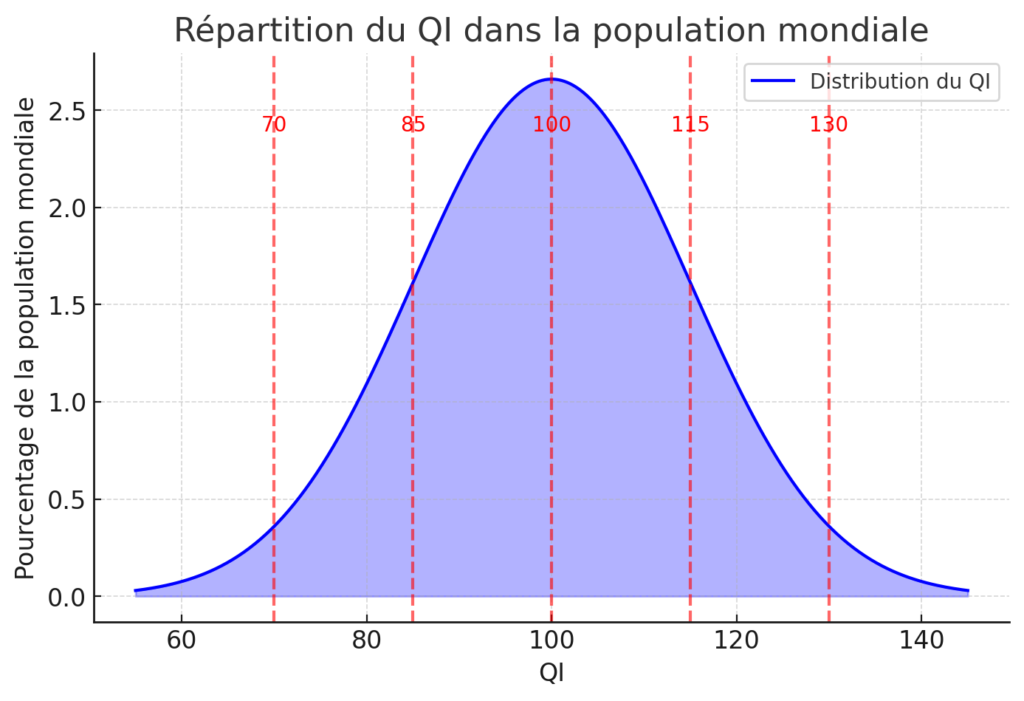
25% of the population lacks the cognitive abilities to reach a good level of language proficiency, which is essential.

A question that often arises is that of destiny. Do we really have control over our lives?

Since I need to find a job, I find myself in the situation of someone who belongs to the 25.25% of the world’s population with an IQ lower than 90, which is supposedly the IQ necessary to use a language adequately for all administrative tasks.
If I’m not completely illiterate in Japanese, I’m far from a native level when it comes to topics or subjects I haven’t covered. This goes without saying, but “instant knowledge” doesn’t exist; we only know what we’ve learned.

The point of today’s reflection is not to feel sorry for myself, but rather to highlight the difficulties that more than a quarter of the world’s population face on a daily basis.

Not being comfortable reading is not just a burden for reading but also for learning, obviously. And someone struggling in their language will face other additional difficulties, such as the fear of expressing themselves, the fear of mockery, a sense of inferiority, and self-denial.

We quickly forget these differences, and we judge too quickly, in a more general way.

Does a person not express themselves, for example, because they don’t want to, or because they can’t?

Does the fact that the vast majority of people have no issues with language mean we should disregard others? Just because they don’t have the necessary abilities to do so?

The example of language is easy to understand for an expatriate who doesn’t master the language of the country they live in.

Immigration is a complicated issue. But in very simple terms, if there is no “need” to leave one’s country in the first place, there would be no immigration.

Looking at things from a global perspective, it almost becomes obvious that to solve immigration problems, providing the necessary resources to the countries of the people who emigrate is one of the key factors.

The reasons for fleeing one’s country are diverse, of course. But extreme poverty, malnutrition, and directly linked to these, lack of education, are among the determining factors.

Anyway, I need to work on my Japanese.

Our latest tales

  • Darkness and Starlight

    Darkness and Starlight

    Cha Cha, our beloved platypus, gazed at the cloudless sky, illuminated by countless stars that made him reflect on how small his own existence was compared to the vastness of the universe. He thought about how the discovery of StarDust in Esperia was also the discovery of the Shadow. “If there is no light, we

    Read more

  • Know Your Enemy

    Know Your Enemy

    This was the title of a class given by Faya, the Shape of Willpower, and Element of Fire.The Espers were a little surprised, since the principles of Esperia were rooted in global harmony. Who, then, could be called an enemy? “Now that we know about the StarDust, we also know about our own Shadow, don’t

    Read more

  • Leader by Example

    Leader by Example

    Kenko, the Shape of Health and the Element of Earth, wasn’t the most eloquent of the Shapes. Her lessons were often very practical, and though she didn’t think much about it, she was the type who led by example. Of course, using one’s own body requires more than words. For exercise, theory alone isn’t enough—you

    Read more

  • The Shadow

    The Shadow

    When the StarDust was discovered, for the very first time its light revealed that within every living form lingered what the 7 Shapes called the Shadow. Eklea, the Shape of Awareness and the Element of Lightning, soon realized that just as a regular shadow requires a source of light to be seen, the same concept

    Read more

  • A calm breeze

    A calm breeze

    Whenever a calm breeze gently carries an ounce of plenitude, it becomes an opportunity to remind ourselves of Gurumin, the Shape of Empathy, and the Element of Wind. Not only the Espers of Esperia, but all living creatures—together with the plants and nature itself—delighted in listening to the wind filled with gentle melodies. The wind

    Read more

  • Information and Truth

    Information and Truth

    Cha Cha, our beloved platypus who dreams of being a philosopher, was reflecting on the great discoveries in science made since the earliest traces of humankind. Technologies have evolved, from the use of stone tools to the potential creation of autonomous AI. Yet Cha Cha was troubled by the sheer overflow of information in modern

    Read more

  • Natural Balance

    Natural Balance

    Living things have a natural way of staying balanced and stable.When it’s hot outside, your body regulates itself by sweating so it doesn’t overheat. When your body needs energy, you feel hungry. When you need water, you feel thirsty. There is a natural balance that keeps you healthy. If you eat too much, you may

    Read more

  • Scars of Time

    Scars of Time

    At the end of the day, what do we remember?For the so-called “favored” on this earth, it is the hours spent at school or work, the moments spent trying to avoid boredom at all costs once we return home. At the end of the year, what do we remember?We set “new goals” for the next

    Read more