25% of the population lacks the cognitive abilities to reach a good level of language proficiency, which is essential.

A question that often arises is that of destiny. Do we really have control over our lives?

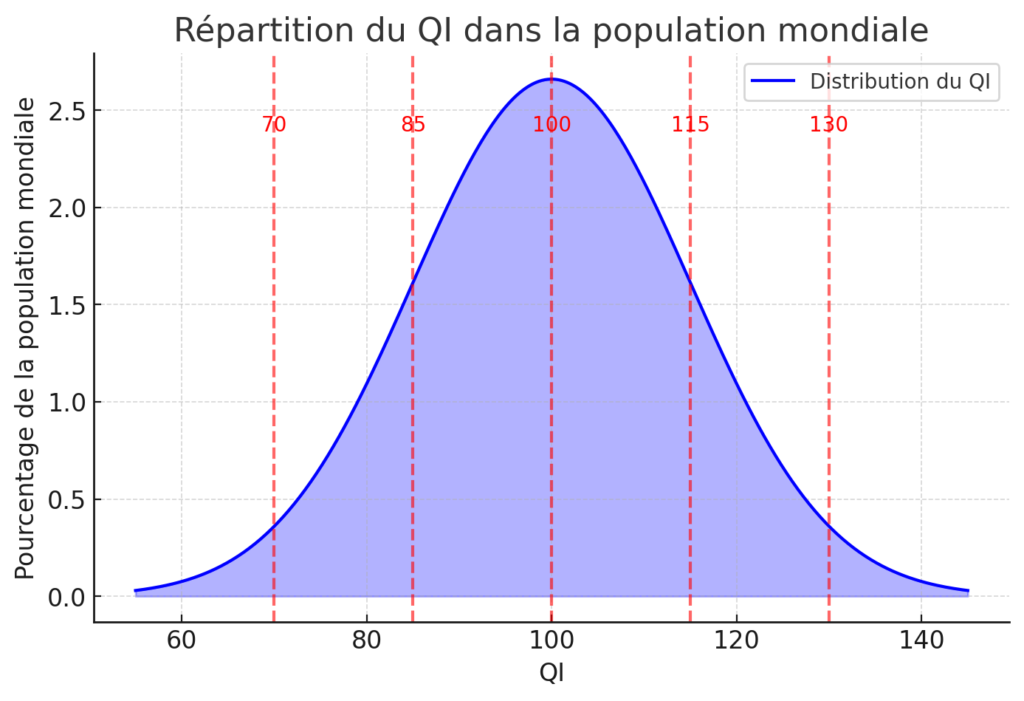
Since I need to find a job, I find myself in the situation of someone who belongs to the 25.25% of the world’s population with an IQ lower than 90, which is supposedly the IQ necessary to use a language adequately for all administrative tasks.
If I’m not completely illiterate in Japanese, I’m far from a native level when it comes to topics or subjects I haven’t covered. This goes without saying, but “instant knowledge” doesn’t exist; we only know what we’ve learned.

The point of today’s reflection is not to feel sorry for myself, but rather to highlight the difficulties that more than a quarter of the world’s population face on a daily basis.

Not being comfortable reading is not just a burden for reading but also for learning, obviously. And someone struggling in their language will face other additional difficulties, such as the fear of expressing themselves, the fear of mockery, a sense of inferiority, and self-denial.

We quickly forget these differences, and we judge too quickly, in a more general way.

Does a person not express themselves, for example, because they don’t want to, or because they can’t?

Does the fact that the vast majority of people have no issues with language mean we should disregard others? Just because they don’t have the necessary abilities to do so?

The example of language is easy to understand for an expatriate who doesn’t master the language of the country they live in.

Immigration is a complicated issue. But in very simple terms, if there is no “need” to leave one’s country in the first place, there would be no immigration.

Looking at things from a global perspective, it almost becomes obvious that to solve immigration problems, providing the necessary resources to the countries of the people who emigrate is one of the key factors.

The reasons for fleeing one’s country are diverse, of course. But extreme poverty, malnutrition, and directly linked to these, lack of education, are among the determining factors.

Anyway, I need to work on my Japanese.


Our latest tales

  • Step by step

    Step by step

    Since she was little, Guruko liked to run in the hills near the small house where she lived with Grandma Luna. She loved climbing trees, rocks, and feeling the touch of the ground on her feet, as well as the smell of the grass when lying down for a quick break. Cha Cha, even as…

    Read more

  • Meditation

    Meditation

    When Guruko was still very young and learning so much from Grandma Luna—about how the Espers lived, and how Esperia was a land of harmony—there was one thing she found hard to understand.It was something a bit like meditation, as humans know it. “The path to grow the seed of Eklea is surely the most…

    Read more

  • Grandma Luna

    Grandma Luna

    Grandma Luna had a mysterious aura around her. Her warm smile and gentle eyes always comforted Guruko whenever she felt a bit sad or lonely. Yet, Grandma Luna often stared at the sky with a hint of melancholy in her gaze. But when Guruko entered the room, a bright smile would instantly return to her…

    Read more

  • The Water Espers

    The Water Espers

    Among all the living beings of Esperia, Vati was especially drawn to the magical creatures known as Espers. They came in many shapes, colors, and abilities, and soon became not only the most powerful but also the most responsible beings in the land. Raised in a world where the Seven Shapes were clearly understood by…

    Read more

  • Rhythm and Nature

    Rhythm and Nature

     Of all the Shapes of Esperia, Atma, the Shape of Balance, was certainly the one most attuned to the music of nature: the wind playing through the gentle leaves of a splendid oak tree, the soft breeze rippling across a calm sea, the birds singing at sunrise in a green valley—and even the raw roar…

    Read more

  • The Creation of Earth

    The Creation of Earth

    Shala was able to witness the creation of Earth too, far, far away from the magical land of Esperia. She was curious and full of joy as she watched life begin to take shape—how, over millions of years, nature slowly unfolded into a world where living beings could grow, flourish, and live in harmony. But…

    Read more

  • The StarDust

    The StarDust

    Cha Cha was also deeply thinking about One Daily Tale, and about the StarDust. The Espers of Esperia had all developed their own StarDust—a bright, shiny, warm veil that reflected rainbow colors. The StarDust allowed the Espers to trust one another, placing fear under the guidance of their awareness and wisdom, and enabling them to…

    Read more

  • Challenge Accepted

    Challenge Accepted

    One Daily Tale was a special book. It was written with magic, and the 7 Shapes themselves spent their time reflecting on how to write and present the important—yet simple—points of the concept, which was linked to harmony with nature and peace for the living creatures of Esperia. This was when Faya stood up a…

    Read more