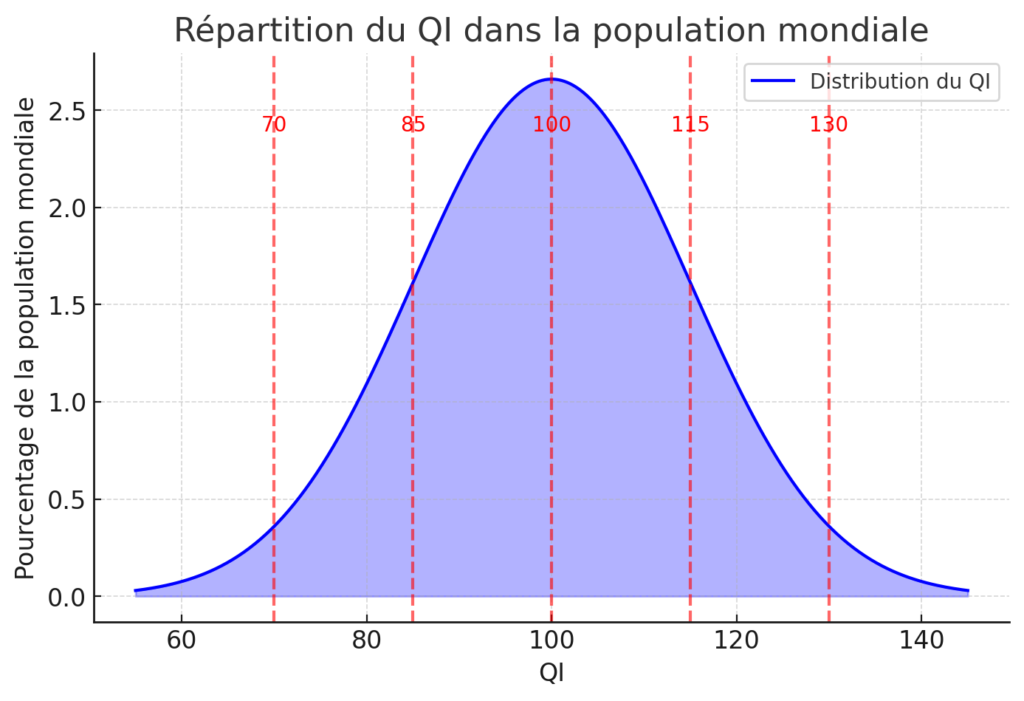
25% of the population lacks the cognitive abilities to reach a good level of language proficiency, which is essential.

A question that often arises is that of destiny. Do we really have control over our lives?

Since I need to find a job, I find myself in the situation of someone who belongs to the 25.25% of the world’s population with an IQ lower than 90, which is supposedly the IQ necessary to use a language adequately for all administrative tasks.
If I’m not completely illiterate in Japanese, I’m far from a native level when it comes to topics or subjects I haven’t covered. This goes without saying, but “instant knowledge” doesn’t exist; we only know what we’ve learned.

The point of today’s reflection is not to feel sorry for myself, but rather to highlight the difficulties that more than a quarter of the world’s population face on a daily basis.

Not being comfortable reading is not just a burden for reading but also for learning, obviously. And someone struggling in their language will face other additional difficulties, such as the fear of expressing themselves, the fear of mockery, a sense of inferiority, and self-denial.

We quickly forget these differences, and we judge too quickly, in a more general way.

Does a person not express themselves, for example, because they don’t want to, or because they can’t?

Does the fact that the vast majority of people have no issues with language mean we should disregard others? Just because they don’t have the necessary abilities to do so?

The example of language is easy to understand for an expatriate who doesn’t master the language of the country they live in.

Immigration is a complicated issue. But in very simple terms, if there is no “need” to leave one’s country in the first place, there would be no immigration.

Looking at things from a global perspective, it almost becomes obvious that to solve immigration problems, providing the necessary resources to the countries of the people who emigrate is one of the key factors.

The reasons for fleeing one’s country are diverse, of course. But extreme poverty, malnutrition, and directly linked to these, lack of education, are among the determining factors.

Anyway, I need to work on my Japanese.

Our latest tales

  • A Shared Pool of Willpower

    A Shared Pool of Willpower

    The StarDust, like all things, is governed by rules. With Vati’s guidance, the Seven Shapes soon came to understand this. And one of these rules concerned Willpower, and how its use was like drawing from a shared pool. Whenever an Esper used their will to take on tasks that were frustrating or required deep focus,

    Read more

  • Little by Little

    Little by Little

    This was one of the mottos of Kenko, the Shape of Health. “A bit of exercise every day is far more effective in the long run than one full day of training, followed by months of nothing.” Now that the StarDust is known by all the Espers, it makes complete sense. Shala always reminds the

    Read more

  • Ask Questions

    Ask Questions

    Eklea and Vati soon became very good friends. Eklea, the Shape of Awareness, always loved asking questions, which came to her mind as swiftly as her Element of Lightning. In Vati, the Shape of Wisdom, she found a companion who would always listen and think along with her. Vati was often surprised by the questions

    Read more

  • Innocence

    Innocence

    The Seven Shapes understood that for the Espers to act in unison, there needed to be shared values and goals — a common foundation for a new beginning. Gurumin, the Shape of Empathy, became a symbol of what must be protected, and of why working together was the only way forward. Her innocence was admired

    Read more

  • I Want to Know

    I Want to Know

    Just as being able to say “I don’t know” is a sign of wisdom, wanting to know—rather than passively accepting things as truth—is yet another mark of it. “It is so easy to accept facts as they are, without trying to understand whether they are true or the reasons behind them,” taught Vati, the Shape

    Read more

  • Triple Point

    Triple Point

    Reflections on how to build a world with harmony at its center led the Seven Shapes to place balance at the heart of the matter. Atma, the Shape of Balance—born from the fusion of all Five Elements and the discovery of the StarDust—was understood to be the key to solving this challenge. They contemplated the

    Read more

  • A Decisive Time

    A Decisive Time

    Shala and Vati discussed extensively the development of StarDust throughout the lifetime of an Esper. One of their conclusions was that even before the birth of a new Esper, the time spent in the mother’s womb had already begun to shape what its future StarDust would eventually become. Broadly speaking, childhood is the “decisive time.”

    Read more

  • Beliefs

    Beliefs

    We now understand that humans are drawn to stories. Long before the digital era—or even before writing—knowledge was passed down through generations by stories told aloud. Whenever someone tells a story, it is no longer reality but a fiction that carries beliefs within it. The natural fear of danger within our species makes us adopt

    Read more