25% of the population lacks the cognitive abilities to reach a good level of language proficiency, which is essential.

A question that often arises is that of destiny. Do we really have control over our lives?

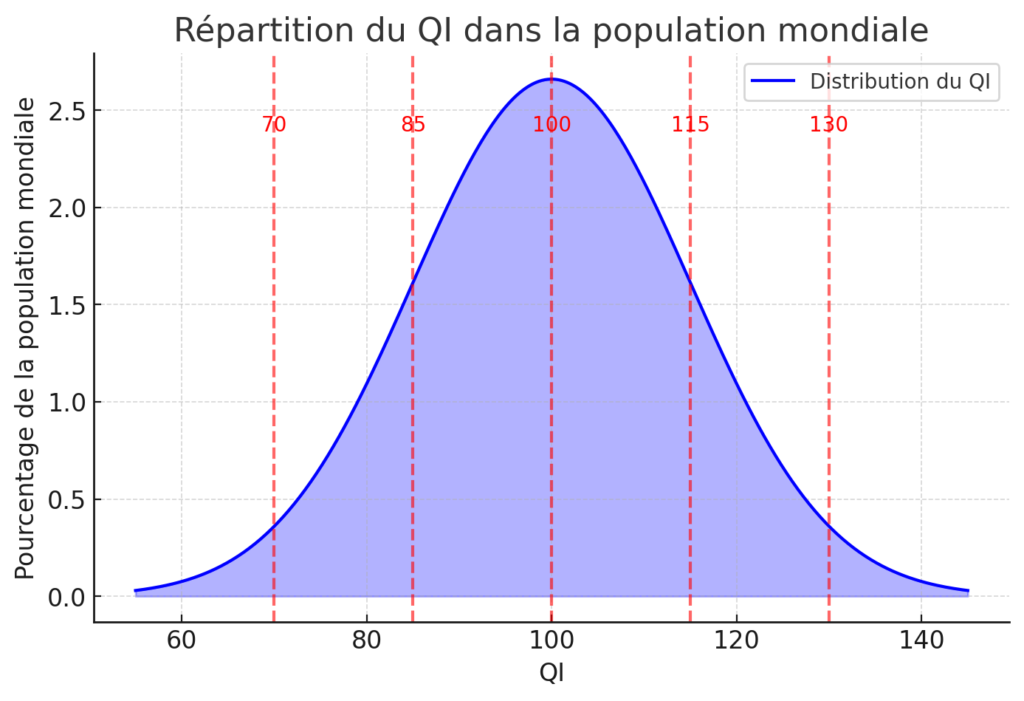
Since I need to find a job, I find myself in the situation of someone who belongs to the 25.25% of the world’s population with an IQ lower than 90, which is supposedly the IQ necessary to use a language adequately for all administrative tasks.
If I’m not completely illiterate in Japanese, I’m far from a native level when it comes to topics or subjects I haven’t covered. This goes without saying, but “instant knowledge” doesn’t exist; we only know what we’ve learned.

The point of today’s reflection is not to feel sorry for myself, but rather to highlight the difficulties that more than a quarter of the world’s population face on a daily basis.

Not being comfortable reading is not just a burden for reading but also for learning, obviously. And someone struggling in their language will face other additional difficulties, such as the fear of expressing themselves, the fear of mockery, a sense of inferiority, and self-denial.

We quickly forget these differences, and we judge too quickly, in a more general way.

Does a person not express themselves, for example, because they don’t want to, or because they can’t?

Does the fact that the vast majority of people have no issues with language mean we should disregard others? Just because they don’t have the necessary abilities to do so?

The example of language is easy to understand for an expatriate who doesn’t master the language of the country they live in.

Immigration is a complicated issue. But in very simple terms, if there is no “need” to leave one’s country in the first place, there would be no immigration.

Looking at things from a global perspective, it almost becomes obvious that to solve immigration problems, providing the necessary resources to the countries of the people who emigrate is one of the key factors.

The reasons for fleeing one’s country are diverse, of course. But extreme poverty, malnutrition, and directly linked to these, lack of education, are among the determining factors.

Anyway, I need to work on my Japanese.


Our latest tales

  • Perspective

    Perspective

    When the StarDust first appeared before the Five Elements, and the Espers who had battled for an endless time, it brought an eerie sensation of plenitude and stillness. Gazing at this mysterious, warm, and bright light—irised with beautiful rainbow colours that flowed gently, like an evident dance—for the first time, the Five Elements could see

    Read more

  • Sad but True

    Sad but True

    Climate change caused by humans is a fact. In just a few hundred years, the use—and abuse—of fossil fuels to develop “human civilization” has shaped a world whose dire consequences we can only begin to fathom. If you live in a wealthy and politically stable country—one that has almost certainly reached this state through environmental

    Read more

  • Mental Overload

    Mental Overload

    Simba, our lovely little monkey-like creature, heard something extremely valuable. Not only does the body have limits, but so does the mind! If you exercise too much, it can lead to injuries. The same is true for mental health. The mind is like a reservoir that can fill with all kinds of emotions. Sometimes it

    Read more

  • Initial Condition

    Initial Condition

    Eklea, the Shape of Awareness, often reminded her students that the Initial Condition of a situation has a significant impact on its outcome. Does that seem obvious? Perhaps—if you’ve thought about it. Does it mean we are bound by where we start? Of course not. But realizing that the starting point is not the same

    Read more

  • The Wind Mirror

    The Wind Mirror

    The Wind Mirror is one of the Five Great Elemental Artifacts, born from the Clash of the Elements at the end of the Chaos War, when the Five Elements cast their strongest spells together at the same time—creating the StarDust. You know how a mirror works, right? You look into it, and it reflects your

    Read more

  • Where ignorance is bliss…

    Where ignorance is bliss…

     …it is folly to be wise. Cha Cha reflected on this sentence. It was written in the 18th century by an English poet. At that time, all energy sources were renewable, with little risk of real damage to the environment, as everything was powered by natural elements or living beings. Sadly, history also shows that

    Read more

  • The Chaos War

    The Chaos War

    It took quite a long time before the Shape of Balance, Atma, and the meaning behind the word “Balance” finally became one of the accepted and evident keys to harmony in Esperia. In principle, it’s simple! In a world with limited resources, there is a clear need for restraint among the living beings who share,

    Read more

  • Past, Present and Future

    Past, Present and Future

    Shala, the Shape of Time, created a lesson about the Past, Present, and Future. “For ordinary living beings who haven’t developed their StarDust yet, it is very difficult to grasp the Scales of Time. Because, in fact, it’s a paradox: it’s not natural to be able to perceive them.” “We all know we live in

    Read more