25% of the population lacks the cognitive abilities to reach a good level of language proficiency, which is essential.

A question that often arises is that of destiny. Do we really have control over our lives?

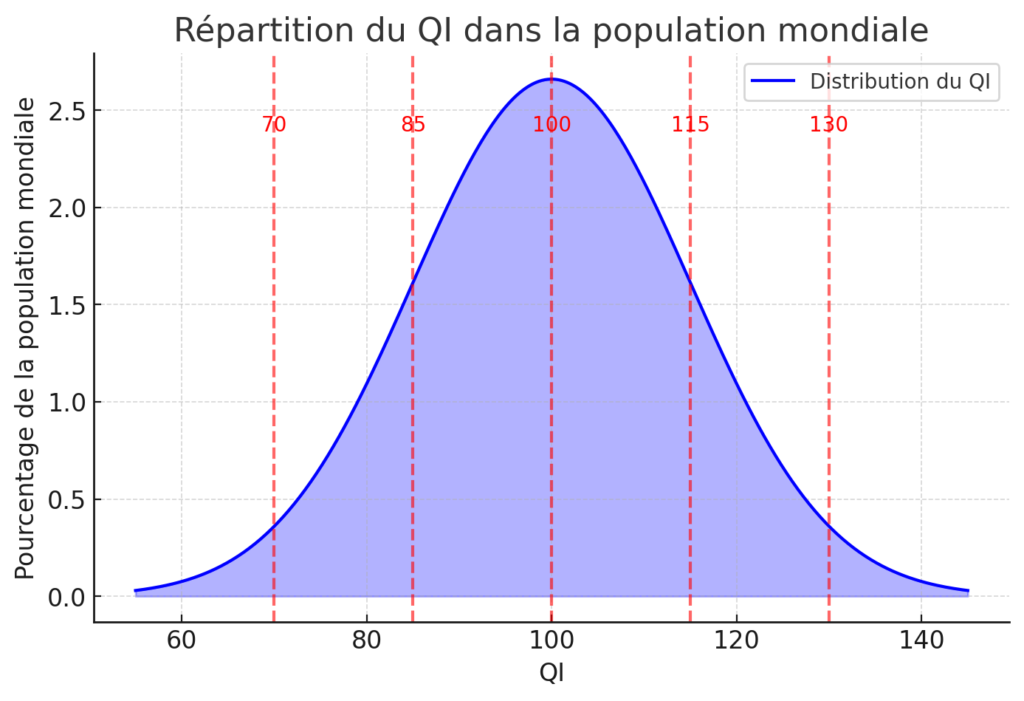
Since I need to find a job, I find myself in the situation of someone who belongs to the 25.25% of the world’s population with an IQ lower than 90, which is supposedly the IQ necessary to use a language adequately for all administrative tasks.
If I’m not completely illiterate in Japanese, I’m far from a native level when it comes to topics or subjects I haven’t covered. This goes without saying, but “instant knowledge” doesn’t exist; we only know what we’ve learned.

The point of today’s reflection is not to feel sorry for myself, but rather to highlight the difficulties that more than a quarter of the world’s population face on a daily basis.

Not being comfortable reading is not just a burden for reading but also for learning, obviously. And someone struggling in their language will face other additional difficulties, such as the fear of expressing themselves, the fear of mockery, a sense of inferiority, and self-denial.

We quickly forget these differences, and we judge too quickly, in a more general way.

Does a person not express themselves, for example, because they don’t want to, or because they can’t?

Does the fact that the vast majority of people have no issues with language mean we should disregard others? Just because they don’t have the necessary abilities to do so?

The example of language is easy to understand for an expatriate who doesn’t master the language of the country they live in.

Immigration is a complicated issue. But in very simple terms, if there is no “need” to leave one’s country in the first place, there would be no immigration.

Looking at things from a global perspective, it almost becomes obvious that to solve immigration problems, providing the necessary resources to the countries of the people who emigrate is one of the key factors.

The reasons for fleeing one’s country are diverse, of course. But extreme poverty, malnutrition, and directly linked to these, lack of education, are among the determining factors.

Anyway, I need to work on my Japanese.


Our latest tales

  • Nurture your StarDust

    Nurture your StarDust

    In Esperia, the Espers had perfectly grasped the importance of nurturing their StarDust—not only for their own good, but for the world they lived in and the other species around them. Shala reminded them that they needed to appreciate the time they had to do things, as the hours in a day were limited. Atma

    Read more

  • The First Step

    The First Step

    Faya was explaining in her lesson about Willpower how the First Step was one of the most important keys to developing it. Some younger Espers had trouble understanding, so she used her own element, Fire, as an example. “In order to create a beautiful and heartwarming, cozy fire, what do we need first?” The young

    Read more

  • Addictions

    Addictions

    Addictions can take many forms. Some are seemingly obvious, and many are aware of them: sugar-laden food, soda, alcohol or tobacco, smartphones and social media, games… Others are less willing to be acknowledged, making them harder to detect. hese include the commercials that keep you “hooked” on the latest products, the social media posts that

    Read more

  • Question your own beliefs

    Question your own beliefs

    Eklea’s teachings were certainly the most difficult to grasp. What exactly is awareness—or consciousness? To help the Espers, she always tried to use concrete examples. And the theme today was: “You should always question your own beliefs.”A younger one asked, “But if that’s what we’ve been taught, shouldn’t our beliefs be right?” “When you learn,

    Read more

  • Pure Heart

    Pure Heart

    Cha Cha was looking at Guruko, who was humming a song she had heard from the birds of the nearby forest. He thought to himself: “Guruko really has a pure heart.” He reflected on how the planet Earth was plagued by raging wars, genocides, and inequity—and how many of its inhabitants were living, oblivious to

    Read more

  • Our own extinction?

    Our own extinction?

    What kind of world are we going to leave behind for future generations?Can we really behave so selfishly that, even though we now fully understand how human behavior has impacted the world, we still choose to ignore what must be done—as if nothing will go terribly wrong if we continue doing nothing? Future generations, not

    Read more

  • A World with Limits

    A World with Limits

    The Espers were magical creatures with incredibly potent skills, but the Seven Shapes—and in particular Atma, the Shape of Balance—were there to remind them that the more power they gained, the more cautiously they had to use it. Without considering the consequences, a new magic could trigger an irreversible chain reaction that might reshape the

    Read more

  • The Cycle of Life

    The Cycle of Life

    The Shape of Time, Shala, had witnessed with her own eyes the beginning of the cycle of life in Esperia. She remembered when nature took form, eventually spreading in harmony with the mountains, the seas, and the rivers. She remembered the first Espers, born with their beautiful inner light, which they would call StarDust. When

    Read more