25% of the population lacks the cognitive abilities to reach a good level of language proficiency, which is essential.

A question that often arises is that of destiny. Do we really have control over our lives?

Since I need to find a job, I find myself in the situation of someone who belongs to the 25.25% of the world’s population with an IQ lower than 90, which is supposedly the IQ necessary to use a language adequately for all administrative tasks.
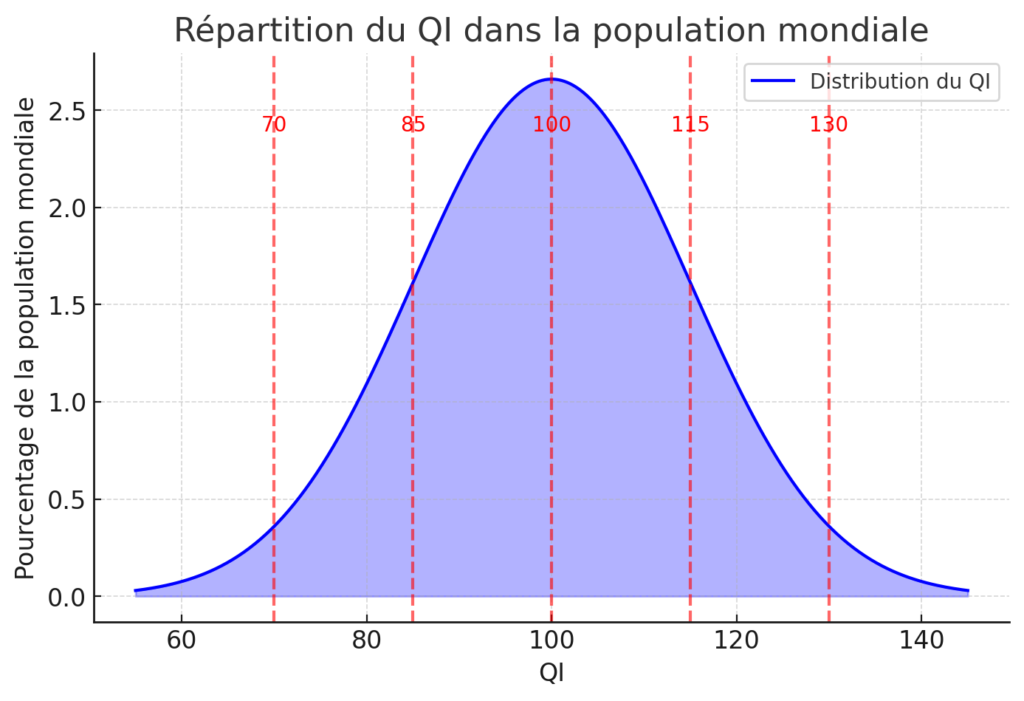
If I’m not completely illiterate in Japanese, I’m far from a native level when it comes to topics or subjects I haven’t covered. This goes without saying, but “instant knowledge” doesn’t exist; we only know what we’ve learned.

The point of today’s reflection is not to feel sorry for myself, but rather to highlight the difficulties that more than a quarter of the world’s population face on a daily basis.

Not being comfortable reading is not just a burden for reading but also for learning, obviously. And someone struggling in their language will face other additional difficulties, such as the fear of expressing themselves, the fear of mockery, a sense of inferiority, and self-denial.

We quickly forget these differences, and we judge too quickly, in a more general way.

Does a person not express themselves, for example, because they don’t want to, or because they can’t?

Does the fact that the vast majority of people have no issues with language mean we should disregard others? Just because they don’t have the necessary abilities to do so?

The example of language is easy to understand for an expatriate who doesn’t master the language of the country they live in.

Immigration is a complicated issue. But in very simple terms, if there is no “need” to leave one’s country in the first place, there would be no immigration.

Looking at things from a global perspective, it almost becomes obvious that to solve immigration problems, providing the necessary resources to the countries of the people who emigrate is one of the key factors.

The reasons for fleeing one’s country are diverse, of course. But extreme poverty, malnutrition, and directly linked to these, lack of education, are among the determining factors.

Anyway, I need to work on my Japanese.

Our latest tales

  • Unity Makes Strength

    Unity Makes Strength

    How the Chaos War ended made it clear to the Seven Shapes that unity brings strength. It was only by combining their magical powers that the StarDust was finally revealed! Until then, no one would have imagined that the key to harmony had always been lying dormant within them. But understanding is one thing; putting…

    Read more

  • Restrictions

    Restrictions

    Atma, the Shape of Balance, was entrusted with one of the most difficult tasks: creating a consensus in which the Espers would agree to limit their use of magic for the good of all Esperia. But understanding the flow of Aether was the starting point of her lesson.Because the world of Esperia has limits, and…

    Read more

  • Time Crisis

    Time Crisis

    The importance of time is often realized only when we finally perceive the fleeting nature of life. Shala, the Shape of Time, knew that better than anyone. Having lived through countless ages, she had watched entire civilizations rise and fall, and the endless cycle of life and death had brought her both joy and sorrow.…

    Read more

  • Enjoy Boredom

    Enjoy Boredom

    The “modern world” now offers countless movies to watch, games to play, and things to own. Meanwhile, the physical realities of the world we live in have become invisible to us, in a society where “the sky is the limit” is the mantra of leading nations. Unfortunately, our planet Earth does have limits—limits we’ve come…

    Read more

  • Natural Laziness

    Natural Laziness

    This course was designed by Faya, the Shape of Willpower, with the help of the other Shapes. The title was chosen to help the Espers become aware of their own behavior, and Eklea, the Shape of Awareness, was there to remind them of that. Understanding how their system worked as living beings was the first…

    Read more

  • Theory and Practice

    Theory and Practice

    Kenko, the Shape of Health, worked very hard to create the lessons about health. It was considered one of the most important subjects, for health is the foundation of one’s life! She soon realized that she needed the cooperation of all the other Shapes so that health would hold the central place it deserved among…

    Read more

  • Know Your Shadow

    Know Your Shadow

    With the help of StarDust, the Espers were now able to perceive their own Shadow. This was the first step toward understanding themselves more deeply. The 7 Shapes then turned their attention to the Shadow itself and began to study it in greater depth. Eklea, the Shape of Awareness, was especially intrigued by this discovery.…

    Read more

  • The Valley of Winds

    The Valley of Winds

    There was a place on Esperia called the Valley of Winds. Over the years, the wind had shaped its landscape, forming a breathtaking scenery of soft, warm plains and winding valleys. Magical creatures could often be seen there, moving peacefully, and simply stepping onto its ground helped any Esper understand more deeply the lessons taught…

    Read more