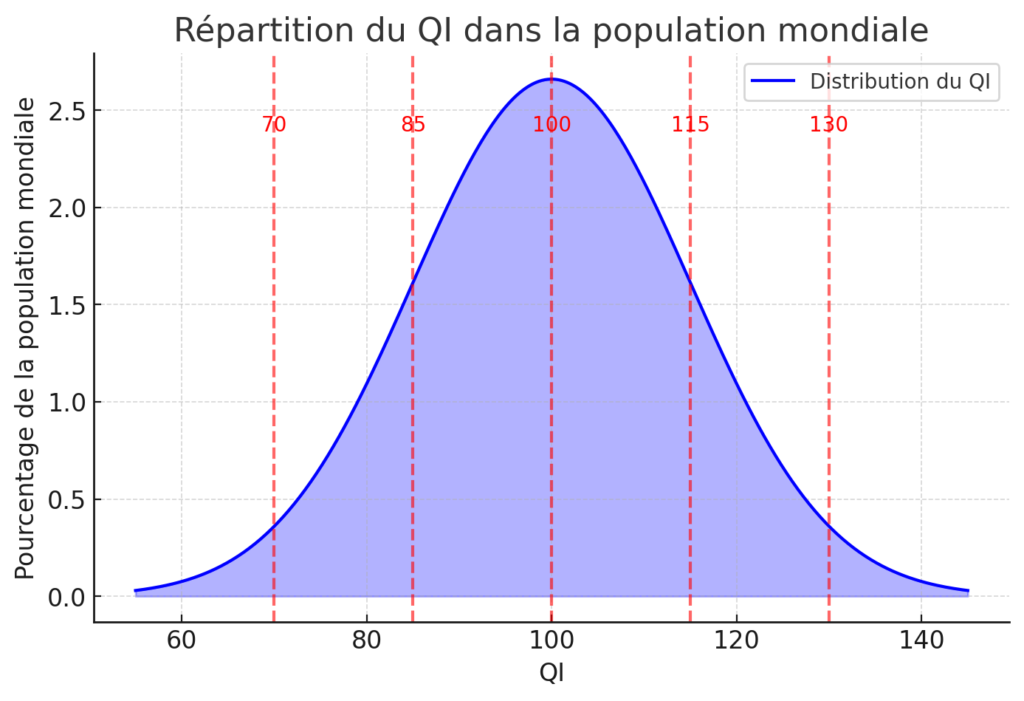
25% of the population lacks the cognitive abilities to reach a good level of language proficiency, which is essential.

A question that often arises is that of destiny. Do we really have control over our lives?

Since I need to find a job, I find myself in the situation of someone who belongs to the 25.25% of the world’s population with an IQ lower than 90, which is supposedly the IQ necessary to use a language adequately for all administrative tasks.
If I’m not completely illiterate in Japanese, I’m far from a native level when it comes to topics or subjects I haven’t covered. This goes without saying, but “instant knowledge” doesn’t exist; we only know what we’ve learned.

The point of today’s reflection is not to feel sorry for myself, but rather to highlight the difficulties that more than a quarter of the world’s population face on a daily basis.

Not being comfortable reading is not just a burden for reading but also for learning, obviously. And someone struggling in their language will face other additional difficulties, such as the fear of expressing themselves, the fear of mockery, a sense of inferiority, and self-denial.

We quickly forget these differences, and we judge too quickly, in a more general way.

Does a person not express themselves, for example, because they don’t want to, or because they can’t?

Does the fact that the vast majority of people have no issues with language mean we should disregard others? Just because they don’t have the necessary abilities to do so?

The example of language is easy to understand for an expatriate who doesn’t master the language of the country they live in.

Immigration is a complicated issue. But in very simple terms, if there is no “need” to leave one’s country in the first place, there would be no immigration.

Looking at things from a global perspective, it almost becomes obvious that to solve immigration problems, providing the necessary resources to the countries of the people who emigrate is one of the key factors.

The reasons for fleeing one’s country are diverse, of course. But extreme poverty, malnutrition, and directly linked to these, lack of education, are among the determining factors.

Anyway, I need to work on my Japanese.

Our latest tales

  • Open your mind

    Open your mind

    In Esperia, when the 7 Shapes wrote One Daily Tale, they thought deeply about one aspect that was utterly important: having an open mind. Why? Because it was one of the fundamental keys to creating a world filled with harmony. With an open mind, two seemingly opposite ideas can eventually merge into one. The concept

    Read more

  • To act or not to act

    To act or not to act

    That is the question. Or more precisely, why should we act—or not? I understand you may be skeptical about trying to do things for other adults, who themselves have the choice to act or not. But children don’t, and it becomes a responsibility—whether we like it or not. We are all born in different places,

    Read more

  • Food is your energy

    Food is your energy

    In Esperia, the Espers soon understood that, in order to create harmony, they needed to prioritize their most fundamental needs. Being magical creatures, they found their source of energy in the natural balance of their elements. The Espers colored with the Earth element, for example, felt revitalized when in contact with mountains. Cha Cha was

    Read more

  • Learn Yourself

    Learn Yourself

    You are you. So you believe you know yourself, right? But when was the last time you truly spent time with yourself—without being distracted by the usual comforts of the developed world? Eklea, the Shape of Awareness, was like a bright and shining star for the Espers of Esperia. Whenever they glimpsed her presence, it

    Read more

  • Hope

    Hope

    When learning about the story of humankind, Guruko began to feel overwhelmed and sad by the countless wars and conflicts that had plagued—and continue to plague—our shared planet we call Earth. Grandma Luna noticed that Guruko wasn’t her usual self, full of joy and smiles.“Is something wrong?” Guruko spoke about the contents of the history

    Read more

  • Believe in your Growth

    Believe in your Growth

    Cha Cha was thinking a lot about the similarities between the StarDust of the Espers and the human brain. For both, in order to develop, it is essential for the individual to truly believe they can grow. In Esperia, this way of thinking had become almost natural and effortless, as the Great Library stood at

    Read more

  • Superhuman?

    Superhuman?

    Our modern civilization, through the industrial revolutions, has enabled humankind to use machines that grant superhuman capacities—to reshape the land, cut down forests, and so forth. This transformation occurred in just a few centuries and has completely altered humanity’s ability to impact the entire world on a global scale. The comic book The World Without

    Read more

  • Survival Instinct

    Survival Instinct

    Living creatures share what is called a survival instinct. When you think about it, it’s rather mysterious. This instinct drives the richest people on the planet to search for ways to achieve immortality—until it becomes too late for them. It leads others to live vicariously through their children. And the irony of this instinct is

    Read more