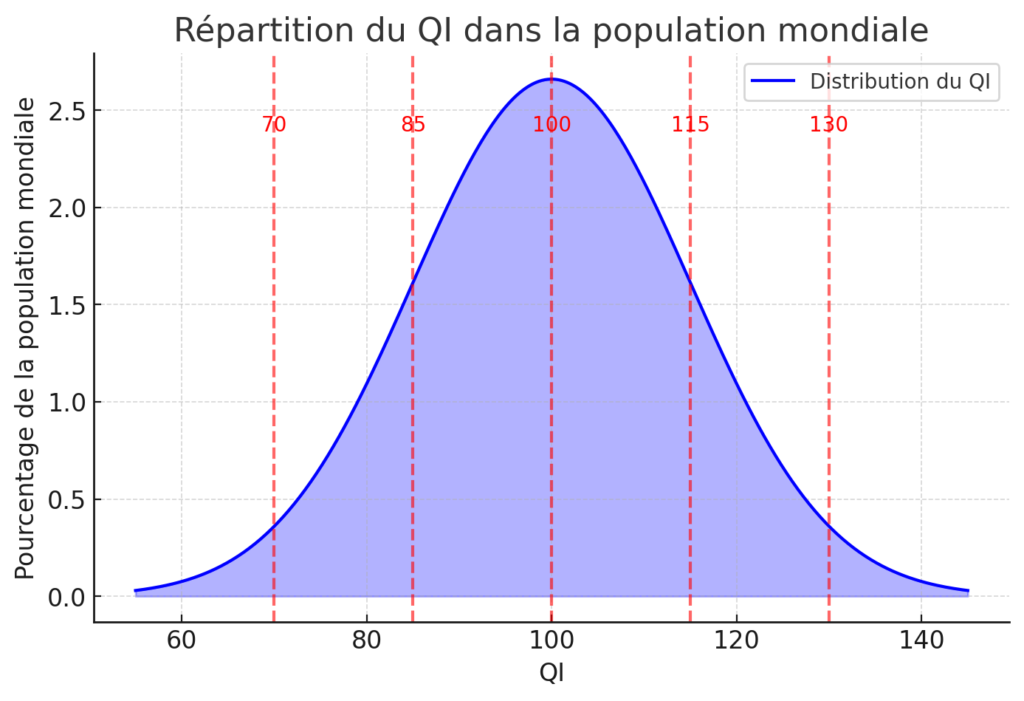
25% of the population lacks the cognitive abilities to reach a good level of language proficiency, which is essential.

A question that often arises is that of destiny. Do we really have control over our lives?

Since I need to find a job, I find myself in the situation of someone who belongs to the 25.25% of the world’s population with an IQ lower than 90, which is supposedly the IQ necessary to use a language adequately for all administrative tasks.
If I’m not completely illiterate in Japanese, I’m far from a native level when it comes to topics or subjects I haven’t covered. This goes without saying, but “instant knowledge” doesn’t exist; we only know what we’ve learned.

The point of today’s reflection is not to feel sorry for myself, but rather to highlight the difficulties that more than a quarter of the world’s population face on a daily basis.

Not being comfortable reading is not just a burden for reading but also for learning, obviously. And someone struggling in their language will face other additional difficulties, such as the fear of expressing themselves, the fear of mockery, a sense of inferiority, and self-denial.

We quickly forget these differences, and we judge too quickly, in a more general way.

Does a person not express themselves, for example, because they don’t want to, or because they can’t?

Does the fact that the vast majority of people have no issues with language mean we should disregard others? Just because they don’t have the necessary abilities to do so?

The example of language is easy to understand for an expatriate who doesn’t master the language of the country they live in.

Immigration is a complicated issue. But in very simple terms, if there is no “need” to leave one’s country in the first place, there would be no immigration.

Looking at things from a global perspective, it almost becomes obvious that to solve immigration problems, providing the necessary resources to the countries of the people who emigrate is one of the key factors.

The reasons for fleeing one’s country are diverse, of course. But extreme poverty, malnutrition, and directly linked to these, lack of education, are among the determining factors.

Anyway, I need to work on my Japanese.

Our latest tales

  • Never stop learning

    Never stop learning

    Esperia had become a world of harmony. Vati reflected on how it had been chaos and war only a few hundred years ago… before the discovery of StarDust, the Shadow within every Esper, and the birth of Atma, the Shape of Balance. With the Great Library at the heart of Esperia, the Seven Shapes had…

    Read more

  • Of Balance and Waves

    Of Balance and Waves

    When Atma was born, she brought with her a new concept. Balance in everything is like a wave: the cycle of day and night, the turning of the seasons, even life and death. There were natural rhythms all around Esperia, and when one looked more closely, they all seemed like waves. Sound, light, the flow…

    Read more

  • Back to the Future

    Back to the Future

    On Esperia, the presence of Shala, the Shape of Time, was essential to help the Espers grasp the notions of future, past, and present. Why? Because any past or future action is nothing more than an action that has once been done in the present! And thus, it was difficult for the Espers to fully…

    Read more

  • Daily

    Daily

    When the StarDust was revealed to the Espers and the Five Elements, it took some time to understand how it worked and what needed to be done in order to nurture it. With the help of Shala, the Shape of Time, and the appearance of Atma, the Shape of Balance, it became clear to the…

    Read more

  • Believe in Yourself

    Believe in Yourself

    On Esperia, Faya—the Shape of Willpower and the Element of Fire—created a special lesson designed to inspire every Esper and remind them of their true worth.It was called “Believe in Yourself.” The first point is simple: believe. Believe in what? That you can always grow, and that every experience can become a chance to learn,…

    Read more

  • Mental Food

    Mental Food

    Just as our nutrition shapes our health, what we feed our minds also has a powerful influence on who we become. Today, with constant access to an almost infinite stream of information through mobile phones, what we choose to consume becomes the food that nourishes—or weakens—our thoughts. As always, knowing this is one thing. Acting…

    Read more

  • Viewpoint

    Viewpoint

    Eklea loved challenging the young Espers with small mental games. “Think about how you see the world. Look around you, and try to imagine viewing it through the eyes of your best friend sitting beside you, the tree in Esperia’s garden nearby, or even one of the countless stars shining in our night sky!” “By…

    Read more

  • Your Loved Ones

    Your Loved Ones

    For children, they are your parents and siblings. Then come friends at school or work. Later, a partner, and your own children. Then the cycle repeats. With the flow of time, we sometimes forget to truly care for our loved ones. Old history may have loosened bonds, or simply living our lives leads us down…

    Read more