25% of the population lacks the cognitive abilities to reach a good level of language proficiency, which is essential.

A question that often arises is that of destiny. Do we really have control over our lives?

Since I need to find a job, I find myself in the situation of someone who belongs to the 25.25% of the world’s population with an IQ lower than 90, which is supposedly the IQ necessary to use a language adequately for all administrative tasks.
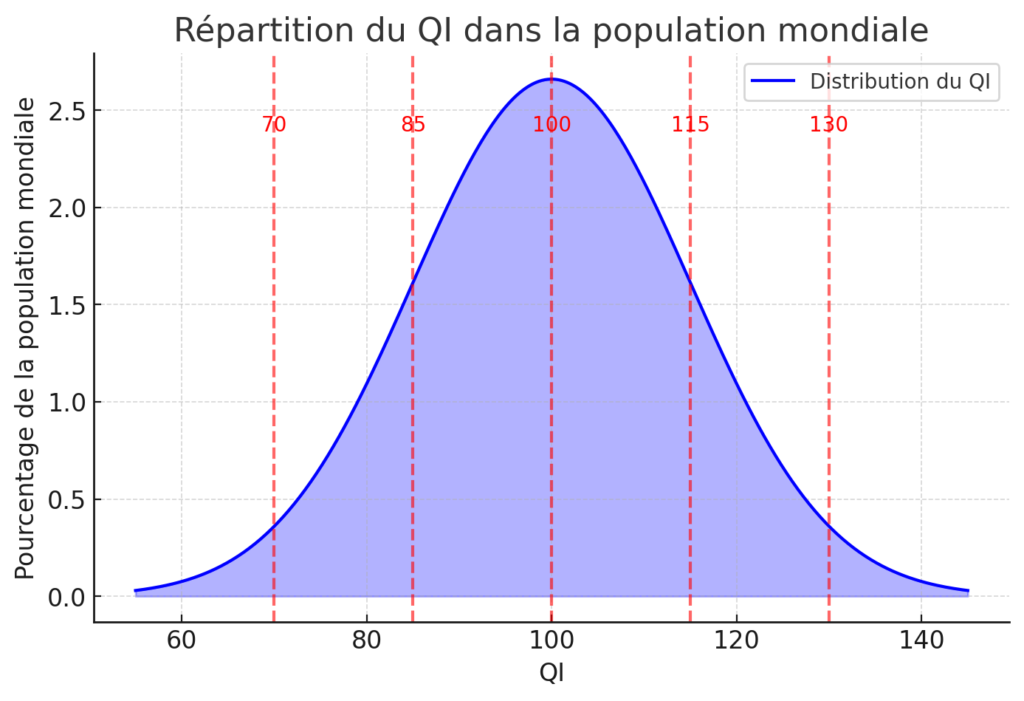
If I’m not completely illiterate in Japanese, I’m far from a native level when it comes to topics or subjects I haven’t covered. This goes without saying, but “instant knowledge” doesn’t exist; we only know what we’ve learned.

The point of today’s reflection is not to feel sorry for myself, but rather to highlight the difficulties that more than a quarter of the world’s population face on a daily basis.

Not being comfortable reading is not just a burden for reading but also for learning, obviously. And someone struggling in their language will face other additional difficulties, such as the fear of expressing themselves, the fear of mockery, a sense of inferiority, and self-denial.

We quickly forget these differences, and we judge too quickly, in a more general way.

Does a person not express themselves, for example, because they don’t want to, or because they can’t?

Does the fact that the vast majority of people have no issues with language mean we should disregard others? Just because they don’t have the necessary abilities to do so?

The example of language is easy to understand for an expatriate who doesn’t master the language of the country they live in.

Immigration is a complicated issue. But in very simple terms, if there is no “need” to leave one’s country in the first place, there would be no immigration.

Looking at things from a global perspective, it almost becomes obvious that to solve immigration problems, providing the necessary resources to the countries of the people who emigrate is one of the key factors.

The reasons for fleeing one’s country are diverse, of course. But extreme poverty, malnutrition, and directly linked to these, lack of education, are among the determining factors.

Anyway, I need to work on my Japanese.


Our latest tales

  • Humility

    Humility

    We are all born with different cards in our hands and raised under various conditions. For most of us, we have received a tremendous number of gifts! These may come in the form of being born in a peaceful, wealthy country, or being raised by parents who did their best despite their flaws. It can

    Read more

  • Us (and Them)

    Us (and Them)

    Just as the brain needs failure to grow, it also needs to overcome adversity in order to learn. If there is no obstacle, why progress? The twist is that throughout history, this need for obstacles has sometimes taken the form of creating enemies. In many languages, this took the name of “barbarians.” In ancient times,

    Read more

  • Muscles

    Muscles

    With age, we slowly begin to lose muscle mass naturally. And in many sedentary countries, desk work doesn’t help make up for this loss. That’s why it’s important to do a few exercises—ideally every day—to rebuild the muscles that are lost. It’s a combination of a few things: More muscles also mean more calories burned

    Read more

  • Curiosity

    Curiosity

    Have you noticed how young children ask so many questions about everything new they discover, hear, or see? This curiosity and fascination with the world is a gift that should be nurtured as much as possible. Why? Because being curious leads us to learn about things, rather than simply accepting them as they are. It

    Read more

  • Children

    Children

    If the debate between nature and nurture has endured through the ages, looking at it from the perspective of brain development makes it clear that nurture plays a significant role in shaping who a person becomes as an adult. Even in the womb, before the cognitive parts of the brain have fully developed, the emotional

    Read more

  • Learn to Learn

    Learn to Learn

    Guided by the 7 Shapes, the Espers realized that their StarDust was the result of the teachings shared by all of them. One of the important things they also understood was that, no matter what they tried to do, the will to do it was extremely important. The funny thing is, in order to learn,

    Read more

  • Through our eyes

    Through our eyes

    We tend to reproduce what we see, and we tend to want what we are shown. This sounds obvious, but it’s precisely why marketing works so well: the more you are presented with a product, the more unconsciously familiar it becomes—and eventually, you’ll want it for yourself. What if, instead, society promoted a lifestyle that

    Read more

  • Resources

    Resources

    On Esperia, the laws of physics were very different from those we know on Earth. This allowed the Espers to use magical powers. But they were also deeply aware of the land they lived in, and the natural presence of the 7 Shapes always reminded them that they needed to live in balance with the

    Read more