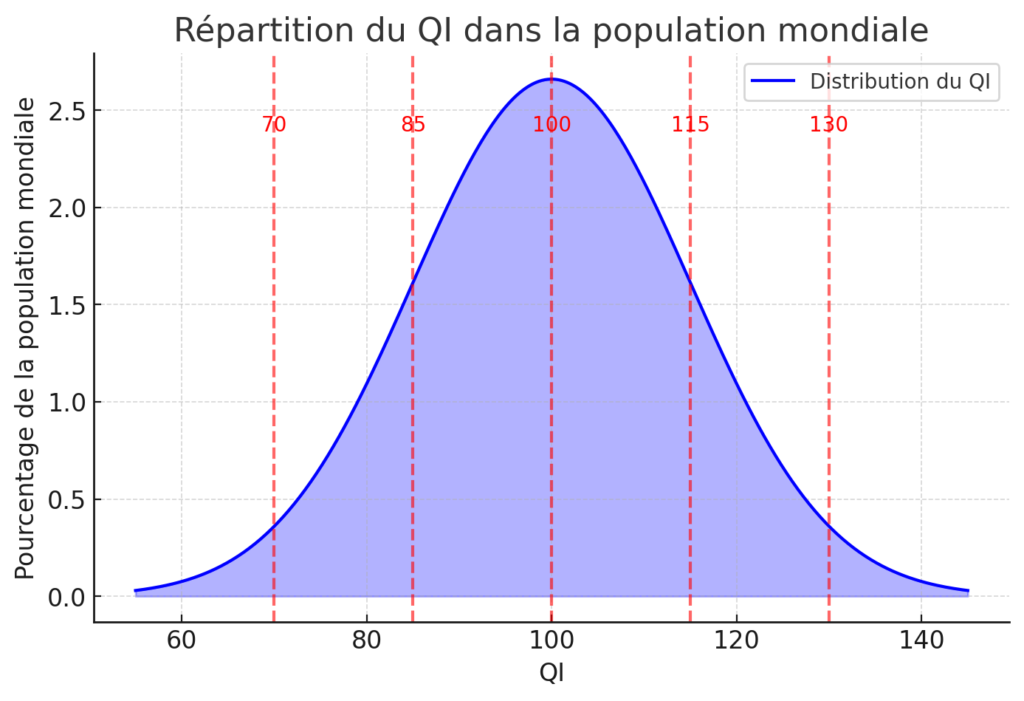
25% of the population lacks the cognitive abilities to reach a good level of language proficiency, which is essential.

A question that often arises is that of destiny. Do we really have control over our lives?

Since I need to find a job, I find myself in the situation of someone who belongs to the 25.25% of the world’s population with an IQ lower than 90, which is supposedly the IQ necessary to use a language adequately for all administrative tasks.
If I’m not completely illiterate in Japanese, I’m far from a native level when it comes to topics or subjects I haven’t covered. This goes without saying, but “instant knowledge” doesn’t exist; we only know what we’ve learned.

The point of today’s reflection is not to feel sorry for myself, but rather to highlight the difficulties that more than a quarter of the world’s population face on a daily basis.

Not being comfortable reading is not just a burden for reading but also for learning, obviously. And someone struggling in their language will face other additional difficulties, such as the fear of expressing themselves, the fear of mockery, a sense of inferiority, and self-denial.

We quickly forget these differences, and we judge too quickly, in a more general way.

Does a person not express themselves, for example, because they don’t want to, or because they can’t?

Does the fact that the vast majority of people have no issues with language mean we should disregard others? Just because they don’t have the necessary abilities to do so?

The example of language is easy to understand for an expatriate who doesn’t master the language of the country they live in.

Immigration is a complicated issue. But in very simple terms, if there is no “need” to leave one’s country in the first place, there would be no immigration.

Looking at things from a global perspective, it almost becomes obvious that to solve immigration problems, providing the necessary resources to the countries of the people who emigrate is one of the key factors.

The reasons for fleeing one’s country are diverse, of course. But extreme poverty, malnutrition, and directly linked to these, lack of education, are among the determining factors.

Anyway, I need to work on my Japanese.


Our latest tales

  • Positive patience

    Positive patience

    Faya, the Shape of Willpower, and Vati, the Shape of Wisdom, combined their efforts to write a lecture about positive patience. The Seven Shapes often had to work together in order to write for One Daily Tale. Indeed, the combination of their strengths was what led to the discovery of how the StarDust that lies

    Read more

  • Unable to sleep

    Unable to sleep

    Today, Kenko, the Shape of Health, wanted to talk about something the Espers often overlooked: the importance of sleep. “Sleep is so important for your health that being unable to sleep may be one of the most detrimental things that can happen,” she warned. “This is something that should be addressed as soon as possible,

    Read more

  • Self-centered

    Self-centered

    “Who has never put their own interests before anything else?” asked Eklea, the Shape of Awareness, to the audience attending her class. No one dared to raise a hand. “Oh, today’s class is quite conscious of its own behavior, isn’t it?” Eklea continued, a little surprised and pleased. “But you’re all right—we have all been

    Read more

  • With an open mind

    With an open mind

    Gurumin, the Shape of Empathy, was appreciated by all the Espers.In every situation, she would listen openly or make a calm judgment. Her daily attitude toward anyone she met was a reflection of her pure heart. “As much as possible, I try my best to keep an open mind,” she would say. “It is not

    Read more

  • Superficial knowledge

    Superficial knowledge

    Vati, as the Shape of Wisdom, had the difficult task of trying to teach the principles written in One Daily Tale regarding wisdom, while not being perceived as cocky or overly special, like a genius. She liked to couple her lessons with Eklea, the Shape of Awareness. The two of them had been great friends

    Read more

  • Reckless mass production

    Reckless mass production

    Guruko and her platypus companion, Cha Cha, were once again observing our world through their magical mirror. With the development of machines and ways to produce goods in mass, some reckless behaviors have emerged, focused solely on mass production without thinking of the consequences it may have. Goods that won’t sell are trashed, adding to

    Read more

  • Promising future

    Promising future

    The discovery of the StarDust and how to nurture it was a first among the many civilizations Shala had seen throughout time and space. Esperia was the first planet where the living creatures we know as the Espers had come to understand their inner StarDust. “Knowing that may be the key to a promising future…”

    Read more

  • Three-Legged Race

    Three-Legged Race

    Do you know the concept of the three-legged race? It is a race in which two people link their inner ankles together and run in unison. Thus, it is also a metaphor for two people working together to accomplish something. Because each person runs on three legs, coordination is crucial, as being out of sync

    Read more