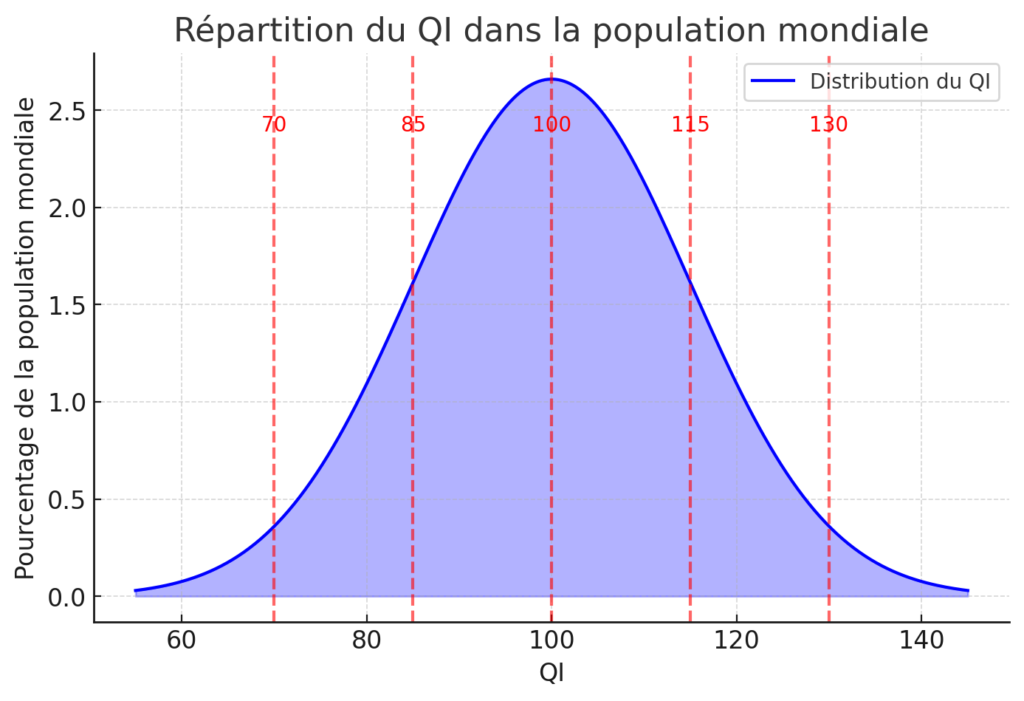
25% of the population lacks the cognitive abilities to reach a good level of language proficiency, which is essential.

A question that often arises is that of destiny. Do we really have control over our lives?

Since I need to find a job, I find myself in the situation of someone who belongs to the 25.25% of the world’s population with an IQ lower than 90, which is supposedly the IQ necessary to use a language adequately for all administrative tasks.
If I’m not completely illiterate in Japanese, I’m far from a native level when it comes to topics or subjects I haven’t covered. This goes without saying, but “instant knowledge” doesn’t exist; we only know what we’ve learned.

The point of today’s reflection is not to feel sorry for myself, but rather to highlight the difficulties that more than a quarter of the world’s population face on a daily basis.

Not being comfortable reading is not just a burden for reading but also for learning, obviously. And someone struggling in their language will face other additional difficulties, such as the fear of expressing themselves, the fear of mockery, a sense of inferiority, and self-denial.

We quickly forget these differences, and we judge too quickly, in a more general way.

Does a person not express themselves, for example, because they don’t want to, or because they can’t?

Does the fact that the vast majority of people have no issues with language mean we should disregard others? Just because they don’t have the necessary abilities to do so?

The example of language is easy to understand for an expatriate who doesn’t master the language of the country they live in.

Immigration is a complicated issue. But in very simple terms, if there is no “need” to leave one’s country in the first place, there would be no immigration.

Looking at things from a global perspective, it almost becomes obvious that to solve immigration problems, providing the necessary resources to the countries of the people who emigrate is one of the key factors.

The reasons for fleeing one’s country are diverse, of course. But extreme poverty, malnutrition, and directly linked to these, lack of education, are among the determining factors.

Anyway, I need to work on my Japanese.

Our latest tales

  • Shifting the blame

    Shifting the blame

    If there was one thing Faya tried to avoid the most, it was shifting the blame for her own mistakes onto others. As the Shape of Willpower, and the Great Element of Fire, she always took responsibility for her actions, even when those actions turned out to be mistakes. “I know it can be easier

    Read more

  • Completely worn out

    Completely worn out

    This time, Kenko, the Shape of Health, raised the difficult question of exhaustion—of being completely worn out. “I understand that some of you think this may be a sign that you are working hard, or doing your best,” said Kenko. “But you also need to remember how your StarDust works, and how it needs rest

    Read more

  • Half Believing

    Half Believing

    The Espers were magical creatures able to shape reality itself through their powers. Some were said to possess so much power that they could even bend the laws of time and space… With that in mind, it was a world where the question of what was real and what was shaped by magic was omnipresent.

    Read more

  • Like a spring breeze

    Like a spring breeze

    The gentle breeze of spring was often paired with a calm and kind personality, warming the atmosphere just as spring gently takes over winter with its delicate warmth. All the Espers soon found themselves on the same wavelength when spring began. While the Espers of the Wind were the most delighted when spring finally arrived

    Read more

  • Remaining calm

    Remaining calm

    When emergencies occur, it is sometimes tempting to rush into things without proper thought. And to be fair, it can be the right decision and does work sometimes. But often, remaining calm helps us analyze the situation more clearly and avoid doing things that could be detrimental. “How are we supposed to know when to

    Read more

  • Beauty in sunny and rainy days

    Beauty in sunny and rainy days

    “Why can’t every day be sunny? I don’t like it when it rains…” asked a young Esper. “Your point of view is very understandable,” replied Atma, the Shape of Balance. “But think about this: if it were sunny all the time, the nature of Esperia would be completely different, as it needs rain to grow.”

    Read more

  • The Logical Order of Things

    The Logical Order of Things

    The notion of time and its flow was mysterious for the Espers as well. Just like their inner Shadows, which can only be perceived when the StarDust that lies within them finally shines, Time was difficult to grasp without taking the time to think about it. This is where Shala, the Shape of Time, served

    Read more

  • A Stable Society

    A Stable Society

    The Esperia known today is a world of peace, but its history before the discovery of the StarDust was chaotic, marked by countless wars between the different Elements. With One Daily Tale, the Seven Shapes succeeded for the first time in uniting the Five Elements toward the common goal of harmony for every Esper, as

    Read more