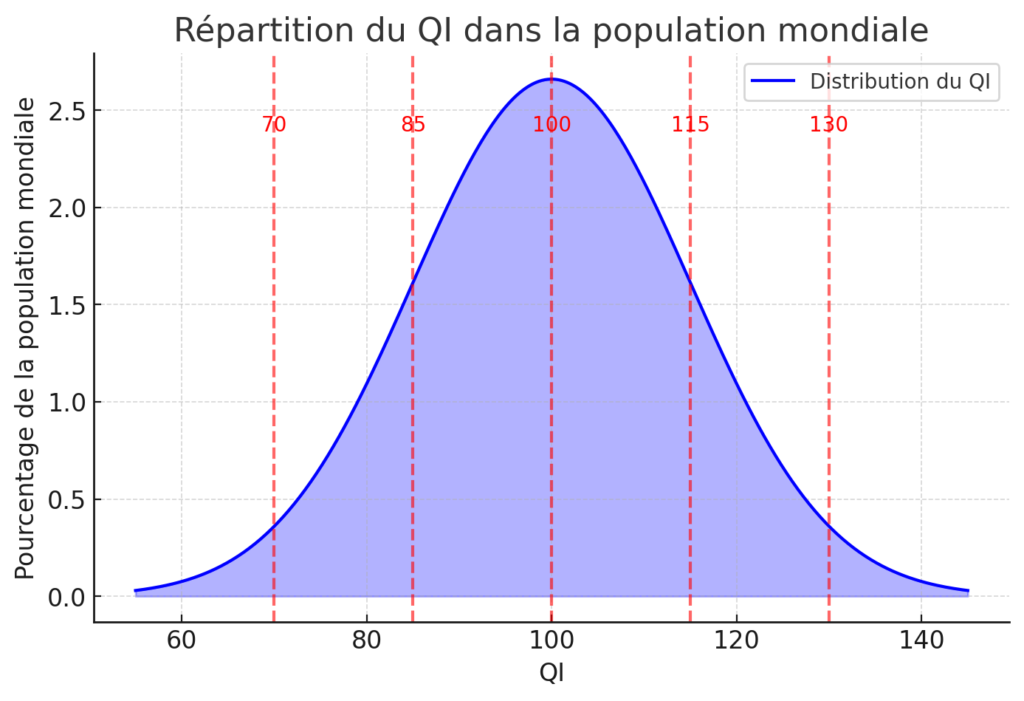
25% of the population lacks the cognitive abilities to reach a good level of language proficiency, which is essential.

A question that often arises is that of destiny. Do we really have control over our lives?

Since I need to find a job, I find myself in the situation of someone who belongs to the 25.25% of the world’s population with an IQ lower than 90, which is supposedly the IQ necessary to use a language adequately for all administrative tasks.
If I’m not completely illiterate in Japanese, I’m far from a native level when it comes to topics or subjects I haven’t covered. This goes without saying, but “instant knowledge” doesn’t exist; we only know what we’ve learned.

The point of today’s reflection is not to feel sorry for myself, but rather to highlight the difficulties that more than a quarter of the world’s population face on a daily basis.

Not being comfortable reading is not just a burden for reading but also for learning, obviously. And someone struggling in their language will face other additional difficulties, such as the fear of expressing themselves, the fear of mockery, a sense of inferiority, and self-denial.

We quickly forget these differences, and we judge too quickly, in a more general way.

Does a person not express themselves, for example, because they don’t want to, or because they can’t?

Does the fact that the vast majority of people have no issues with language mean we should disregard others? Just because they don’t have the necessary abilities to do so?

The example of language is easy to understand for an expatriate who doesn’t master the language of the country they live in.

Immigration is a complicated issue. But in very simple terms, if there is no “need” to leave one’s country in the first place, there would be no immigration.

Looking at things from a global perspective, it almost becomes obvious that to solve immigration problems, providing the necessary resources to the countries of the people who emigrate is one of the key factors.

The reasons for fleeing one’s country are diverse, of course. But extreme poverty, malnutrition, and directly linked to these, lack of education, are among the determining factors.

Anyway, I need to work on my Japanese.


Our latest tales

  • To the best of one’s ability

    To the best of one’s ability

    This chapter of One Daily Tale led at first to many debates among the Espers. Until then, they didn’t know about the StarDust, how to develop it, or how it could help them understand themselves better: the light created by their StarDust would enable them to see their inner Shadow, often hidden deep inside them.

    Read more

  • Excessive drinking and eating

    Excessive drinking and eating

    Kenko, the Shape of Health, knew too well that most of the Espers would not want to hear her words at first. Why? Because she knew that once one has tasted the ease of luxury, of addiction through alcohol, and forgotten the hardship of simply being able to eat every day, it requires far more

    Read more

  • A fast pace of change : Shippu Jinrai

    A fast pace of change : Shippu Jinrai

    The End of the Chaos War came when the Five Great Elements used their most powerful spell together, all at once, revealing for the first time in the history of Esperia the existence of the StarDust. From that moment on, the world finally understood the need for rapid change, having damaged its own planet more

    Read more

  • To act in one’s own favor

    To act in one’s own favor

    Now that the teachings of One Daily Tale had become the common educational writings for all the Espers of Esperia, following its principles had become evident and natural. But newborn Espers were all born as complete blank pages, shaped by their closest environment. Some Espers who had been very powerful in the past, when Chaos

    Read more

  • Accepting differences

    Accepting differences

    Now that Esperia was finally at peace, it became natural for the five different Elements to work together and share their knowledge and skills. When they were still at war, they simply couldn’t realize—blinded by hatred and fear of others—the need for the other Elements to sustain their own land. Water, through rivers, lakes, or

    Read more

  • Overconsumption

    Overconsumption

    Who hasn’t heard the term, but who has really thought about it? Guruko, who was very intrigued by the human race on Earth, was once again looking through the magical mirror at their civilization. “They are quite interesting living beings, aren’t they?” said Cha Cha, her platypus companion, who had just walked into the room

    Read more

  • A short period of power

    A short period of power

    What was unprecedented on Esperia was how detached from power and status the founders of One Daily Tale were. The Seven Shapes were mainly symbols of what good behavior toward one’s StarDust could lead to: harmony and peace. They were living examples of what they wrote as guides for everyone, themselves included. In the past,

    Read more

  • Losing unity

    Losing unity

    Once again, Guruko and her platypus companion Cha Cha were observing human society on Earth. Cha Cha, also known as Simba as his pen name (he wants to become a philosopher-writer!), was thinking about the two different paths that seemed possible for humanity regarding the new technology they were now developing. “Once again, it seems

    Read more