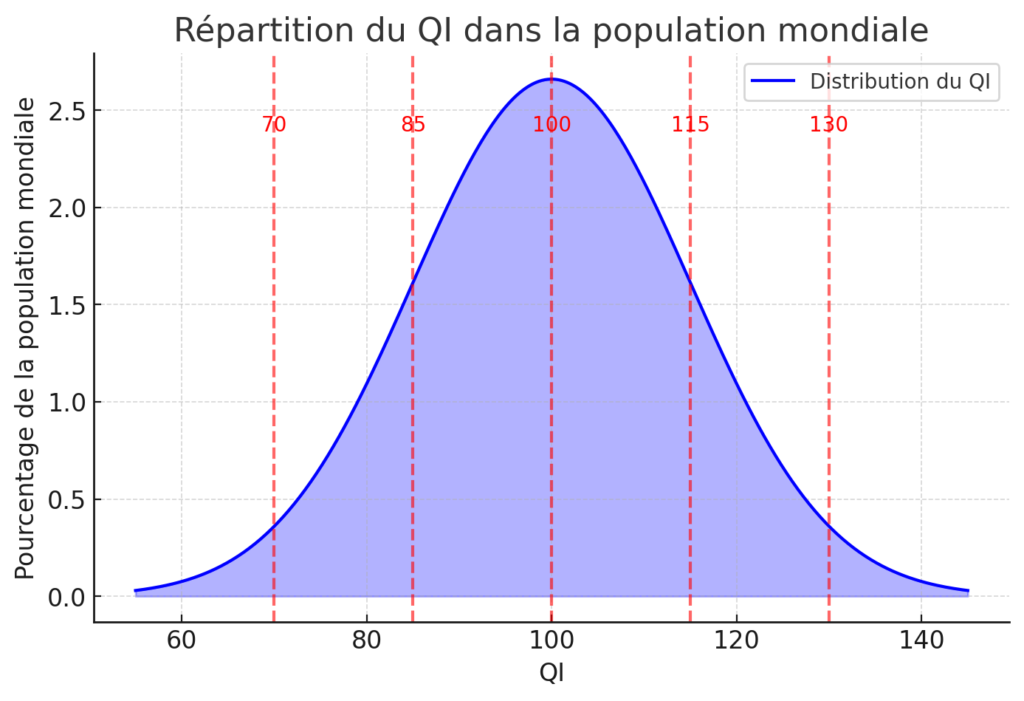
25% of the population lacks the cognitive abilities to reach a good level of language proficiency, which is essential.

A question that often arises is that of destiny. Do we really have control over our lives?

Since I need to find a job, I find myself in the situation of someone who belongs to the 25.25% of the world’s population with an IQ lower than 90, which is supposedly the IQ necessary to use a language adequately for all administrative tasks.
If I’m not completely illiterate in Japanese, I’m far from a native level when it comes to topics or subjects I haven’t covered. This goes without saying, but “instant knowledge” doesn’t exist; we only know what we’ve learned.

The point of today’s reflection is not to feel sorry for myself, but rather to highlight the difficulties that more than a quarter of the world’s population face on a daily basis.

Not being comfortable reading is not just a burden for reading but also for learning, obviously. And someone struggling in their language will face other additional difficulties, such as the fear of expressing themselves, the fear of mockery, a sense of inferiority, and self-denial.

We quickly forget these differences, and we judge too quickly, in a more general way.

Does a person not express themselves, for example, because they don’t want to, or because they can’t?

Does the fact that the vast majority of people have no issues with language mean we should disregard others? Just because they don’t have the necessary abilities to do so?

The example of language is easy to understand for an expatriate who doesn’t master the language of the country they live in.

Immigration is a complicated issue. But in very simple terms, if there is no “need” to leave one’s country in the first place, there would be no immigration.

Looking at things from a global perspective, it almost becomes obvious that to solve immigration problems, providing the necessary resources to the countries of the people who emigrate is one of the key factors.

The reasons for fleeing one’s country are diverse, of course. But extreme poverty, malnutrition, and directly linked to these, lack of education, are among the determining factors.

Anyway, I need to work on my Japanese.

Our latest tales

  • A Trap Named Passivity

    A Trap Named Passivity

    Isn’t it easy to simply watch what’s in front of our eyes and go on with our own lives? Yet what we can see now extends far beyond our neighborhood — the entire world is at our doorstep. Of course, no one can carry all the world’s problems on their own shoulders. But that doesn’t

    Read more

  • The Basic Needs

    The Basic Needs

    Kenko, the Shape of Health, was certain of one thing: unless the basic needs of the Espers were made a priority, Esperia would never know true peace. The right to proper sleep, and access to healthy food and clean water for all, were the very first steps toward creating a harmonious society. These fundamentals were

    Read more

  • Calming Down

    Calming Down

    The Shape of Awareness and Element of Lightning, Eklea, had quite an electric temperament. She loved to bounce from place to place, and as swiftly as roaring thunder, she would try to teach consciousness to anyone willing to listen. But when someone was truly all ears, she could also calm down, creating a gentle electrical

    Read more

  • Finding Yourself Through Love

    Finding Yourself Through Love

    Does this title sound cliché? I guess so. But is it true? Absolutely. Of course, the word love carries as many meanings as there are human beings on our shared planet. For most of us, the first love we experience is that of our mother, who carries us for months and cares for us by

    Read more

  • The “Modern World”

    The “Modern World”

    Cha Cha, our platypus friend, was thinking about what the “Modern World” had become—and how paradoxical it was. Thanks to new technologies that turned machines into the world’s new servants, life had become easier for some of the richest countries. But this comfort came at the cost of irreversible damage to the environment—damage that was

    Read more

  • Moderation

    Moderation

    Before the end of the Chaos War, the concept of moderation scarcely existed among the Espers. They preferred to spend their time wielding magic and battling one another, unaware of the consequences. The birth of Atma, the Shape of Balance, transformed life in Esperia. The Seven Shapes placed moderation as a core principle in the

    Read more

  • Slowing Down

    Slowing Down

    Esperia was built and envisioned so that harmony and peace would be its foundations. Nature and all the creatures living within it created a virtuous circle, and the Espers — the magical beings — finally understood that the restriction on their use of magic served a greater purpose on their interconnected and limited planet. This

    Read more

  • Values

    Values

    What we come to see as “good” values and the proper behaviors to follow are learned throughout our lives. As children, we naturally mimic the actions and thoughts we observe — through the words and gestures of our parents, siblings, teachers, or friends we play with. When we are still very young, we hold no

    Read more